
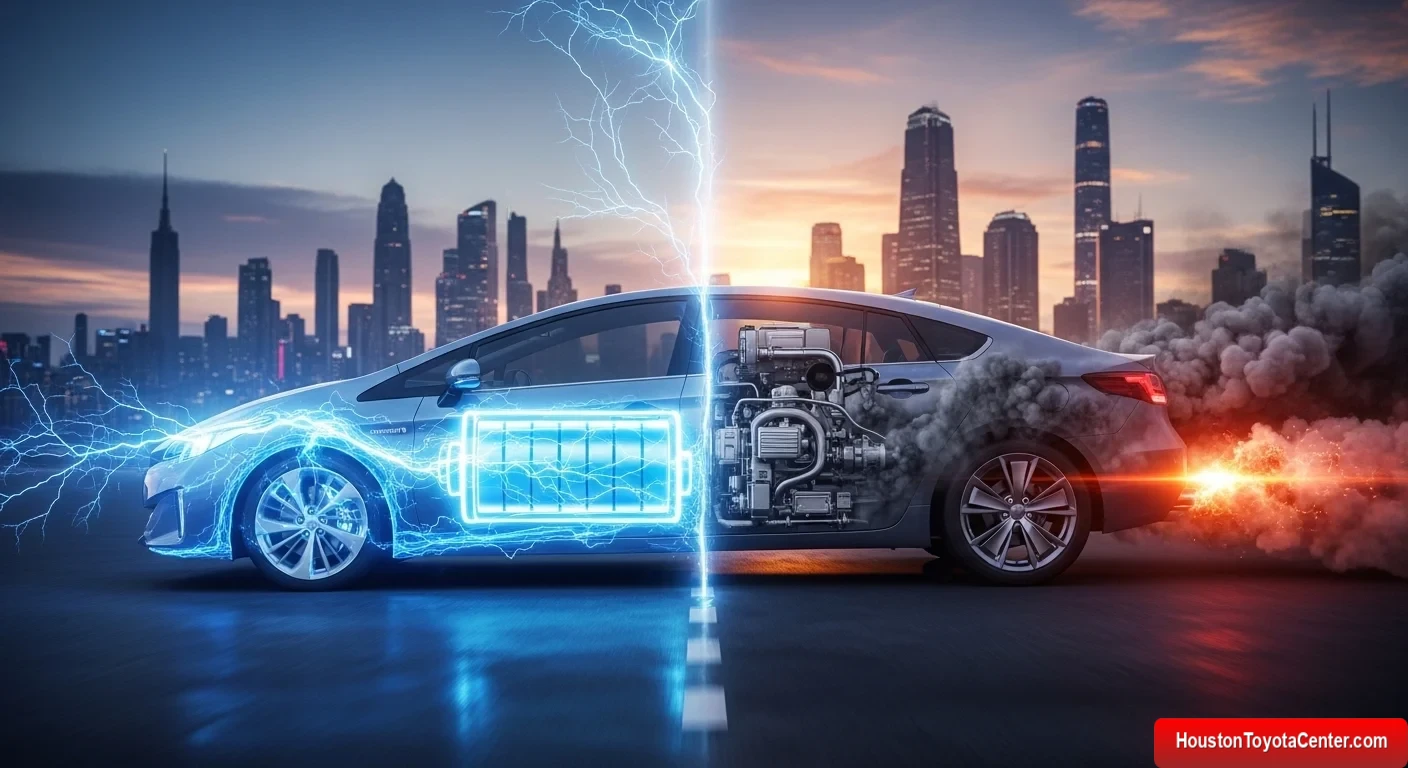
When historians of industry look back at the late twentieth and early twenty-first centuries, they will likely point to one of the most consequential technological pivots in automotive history: the mainstream adoption of hybrid vehicles. While many manufacturers experimented with electrification, it was Toyota Motor Corporation that transformed hybrid technology from a niche engineering curiosity into a global standard.
The company did not merely build a hybrid car. It redefined what hybrid technology meant—technically, commercially, culturally, and strategically. By combining long-term vision, disciplined engineering, manufacturing excellence, and a deep understanding of consumer psychology, Toyota altered the trajectory of the global auto industry.
This is the story of how hybrid technology evolved from experimental prototypes to a cornerstone of sustainable mobility—and how one company led that transformation.
The Pre-Hybrid Landscape: An Industry at a Crossroads
In the 1980s and early 1990s, the global auto industry was dominated by internal combustion engines (ICE). Vehicles were becoming more powerful, larger, and increasingly complex. Fuel economy was improving slowly, but not at a pace that addressed growing environmental concerns.
FREE: Quickly identify and understand problems with your vehicle 🚘
CLICK HERESeveral forces were converging:
- Rising awareness of climate change
- Urban air pollution crises
- Stricter emissions regulations
- Oil price volatility
- Consumer demand for efficiency without sacrificing comfort
In the United States, regulatory bodies such as the California Air Resources Board began pushing aggressive emissions standards. Meanwhile, global environmental agreements were shaping policy conversations worldwide.
Automakers faced a strategic dilemma:
- Improve gasoline engines incrementally
- Invest in full battery electric vehicles (which were immature and expensive at the time)
- Or find a transitional technology that balanced feasibility and sustainability
Most companies hesitated. Toyota did not.
The G21 Project: A Vision Beyond Compliance
In 1993, Toyota launched an internal initiative known as the G21 Project. The goal was ambitious: create a car for the 21st century that would dramatically reduce fuel consumption and emissions without compromising practicality.
This was not a regulatory reaction. It was strategic foresight.
At the time, few consumers were demanding hybrids. Battery technology was limited. Costs were high. Risk was enormous.
But Toyota leadership believed that environmental sustainability would eventually become a core competitive dimension—not merely a compliance burden.
Rather than treating electrification as an experimental sideline, Toyota integrated it into its long-term corporate philosophy.
The Birth of a Disruptor
In 1997, Toyota introduced the first mass-produced hybrid vehicle: the Prius.
While earlier prototypes and limited-production electric vehicles existed, the Prius was different:
- It was practical.
- It was affordable (relatively).
- It required no behavioral compromise.
- It was backed by Toyota’s manufacturing scale.
The car initially launched in Japan, where compact vehicles and fuel efficiency were already valued. By 2000, it entered the United States market.
Many analysts predicted failure.
They were wrong.
What Made Toyota’s Hybrid System Revolutionary?
Toyota did not simply add an electric motor to a gasoline engine. It developed a fully integrated architecture known as the Hybrid Synergy Drive (HSD).
This system featured:
- A gasoline engine optimized for efficiency rather than peak power
- An electric motor providing torque assistance
- A generator
- A planetary gearset enabling seamless power blending
- Regenerative braking
- Advanced power electronics
The Key Innovation: Power Split Device
The planetary gearset allowed the vehicle to:
- Run on electric power alone at low speeds
- Use gasoline power at higher speeds
- Blend both seamlessly when needed
This eliminated the jerky transitions that plagued early hybrid prototypes from competitors.
Drivers did not need to think differently. The system worked automatically.
That was the breakthrough.
Hybrid vs. Mild Hybrid vs. Plug-in Hybrid
To understand Toyota’s redefinition of hybrids, it helps to distinguish between architectures.
| Type of Hybrid | Electric-Only Driving | External Charging | Complexity | Fuel Savings |
|---|---|---|---|---|
| Mild Hybrid | No | No | Low | 5–15% |
| Full Hybrid (Toyota type) | Yes (limited range) | No | Moderate | 30–50% |
| Plug-in Hybrid | Yes (extended range) | Yes | High | 50%+ (depending on use) |
Toyota focused on full hybrids—offering meaningful efficiency gains without requiring charging infrastructure.
This strategic choice removed consumer friction.
Competing Early Attempts
Toyota was not alone in exploring hybridization.
Honda launched the Insight in 1999. It achieved impressive fuel economy but relied on a mild hybrid system and prioritized aerodynamics over practicality.
The Insight was technologically impressive but commercially limited.
Toyota’s approach differed in three major ways:
- Focus on mainstream usability
- Continuous system refinement
- Aggressive cost reduction through scale
Toyota treated hybrid technology as a platform, not a halo product.
Manufacturing Mastery: Scaling the Impossible
Many companies can build prototypes. Few can industrialize them profitably.
Toyota’s real revolution occurred not in the laboratory, but on the production line.
Using the Toyota Production System (TPS), the company:
- Reduced battery costs over time
- Improved inverter efficiency
- Optimized supply chain integration
- Enhanced quality control
- Increased reliability
By the mid-2000s, hybrid reliability matched or exceeded conventional vehicles.
Consumers no longer feared the battery.
The Second-Generation Breakthrough
In 2003, Toyota introduced a redesigned Prius for global markets.
This version featured:
- Improved fuel economy
- More interior space
- A distinctive aerodynamic shape
- Advanced digital dashboard
The car became a cultural symbol—particularly in urban centers like Los Angeles and San Francisco.
In fact, in the state of California, the Prius became synonymous with eco-conscious living.
Celebrities, environmental advocates, and tech professionals adopted it. Hybrid technology shifted from novelty to identity.
Engineering Philosophy: Kaizen Applied to Electrification
Toyota’s principle of kaizen—continuous improvement—guided hybrid development.
Instead of betting on a radical leap to full electrification, Toyota refined hybrid systems generation after generation.
Key improvements included:
- Battery energy density increases
- Reduced rare earth usage
- Enhanced motor efficiency
- Weight reduction
- Thermal management optimization
By iterating systematically, Toyota reduced cost while increasing performance.
Competitors struggled to replicate this disciplined incrementalism.
Hybrid Technology as Strategic Hedge
When pure electric vehicle startups began emerging, many questioned Toyota’s cautious approach.
Companies like Tesla—led by Elon Musk—pushed aggressively toward full battery electric vehicles (BEVs).
Toyota took a different stance:
- Infrastructure was limited
- Battery costs remained high
- Range anxiety persisted
- Consumer readiness varied globally
Rather than choose a single technological future, Toyota diversified:
- Hybrids
- Plug-in hybrids
- Hydrogen fuel cells
- Battery electrics
Hybrids served as a bridge technology—reducing emissions immediately while preserving flexibility.
Environmental Impact at Scale
Critics sometimes argue that hybrids delay full electrification. But the scale of hybrid adoption tells a different story.
By selling millions of hybrid vehicles globally, Toyota:
- Reduced billions of gallons of fuel consumption
- Lowered CO₂ emissions significantly
- Influenced regulatory standards
- Accelerated supplier innovation
Unlike a few thousand early electric vehicles, hybrids achieved mass penetration quickly.
Impact depends on scale—and Toyota understood scale better than anyone.
Consumer Psychology: Redefining Green Without Sacrifice
Early electric vehicles required behavioral adaptation:
- Limited range
- Long charging times
- Sparse infrastructure
Toyota’s hybrids required none of these changes.
Drivers:
- Fueled normally
- Experienced better fuel economy
- Enjoyed quiet operation
- Faced no range anxiety
This psychological friction reduction was critical.
Toyota didn’t ask consumers to become environmental activists. It allowed them to make a practical choice that happened to be sustainable.
That subtle difference redefined adoption curves.
Reliability: The Silent Advantage
Perhaps Toyota’s most underrated achievement was reliability.
Skeptics predicted:
- Battery failures
- Expensive repairs
- Short lifespan
Instead, many early hybrid vehicles exceeded 200,000 miles with minimal battery degradation.
This reliability stemmed from:
- Conservative battery management
- Thermal regulation
- Controlled depth-of-discharge cycles
Trust transformed perception.
Hybrid technology was no longer experimental—it was dependable.
Intellectual Property and Industry Influence
Toyota aggressively patented its hybrid technologies.
Rather than restricting access entirely, the company later licensed certain technologies, influencing broader industry adoption.
Over time, nearly every major automaker developed hybrid systems.
Even companies initially skeptical eventually followed.
Toyota did not just compete—it shaped the rules of the game.
Economic Strategy: Profitable Sustainability
One of the greatest myths about green technology is that it must sacrifice profitability.
Toyota proved otherwise.
By:
- Standardizing hybrid components across multiple models
- Spreading R&D costs over high volumes
- Leveraging supply chain efficiencies
The company made hybrids financially viable.
Eventually, hybrid variants expanded beyond compact cars into:
- Sedans
- SUVs
- Luxury vehicles
- Commercial fleets
Hybrid technology became modular.
Global Expansion and Localization
Hybrid adoption varied by region.
In Japan:
- Strong acceptance
- High fuel prices
- Urban density
In the United States:
- Environmental identity factor
- Fuel economy awareness
In Europe:
- Diesel competition
- Urban emissions regulation
Toyota adapted messaging and product mix accordingly.
In cities like Tokyo, compact efficiency resonated. In American suburbs, hybrid SUVs bridged performance and sustainability.
Localization amplified impact.
The Technological Ecosystem Effect
Toyota’s hybrid leadership stimulated innovation across sectors:
- Battery manufacturing
- Power electronics
- Semiconductor design
- Rare earth material processing
- Software control systems
Suppliers scaled capabilities that later benefited the entire electrification movement.
In effect, Toyota seeded the electrified supply chain.
Criticism and Strategic Tension
Not all observers agreed with Toyota’s path.
Some argued:
- Hybrids slowed BEV adoption
- Hydrogen investment diluted focus
- Competitors were moving faster in full electrics
The debate intensified as Tesla gained market capitalization dominance.
However, hybrid sales remained strong globally, particularly in markets with limited charging infrastructure.
Toyota’s philosophy remained pragmatic:
Electrification must match infrastructure reality.
Hybrid Technology as Cultural Catalyst
Beyond engineering, Toyota changed culture.
The Prius became shorthand for environmental responsibility.
Hybrid badging became aspirational.
Consumers began asking:
- “Is there a hybrid version?”
- “What’s the MPG?”
Efficiency moved from secondary consideration to primary purchase factor.
That cultural shift may be Toyota’s greatest achievement.
Technical Deep Dive: Why the System Works
Several engineering decisions explain Toyota’s durability and efficiency.
1. Atkinson Cycle Engine
The engine sacrifices peak power for improved thermal efficiency.
2. Battery Buffer Strategy
Instead of full charge cycles, Toyota maintains mid-level charge to prolong battery life.
3. Regenerative Optimization
Brake energy recapture reduces wear and enhances efficiency.
4. Seamless Software Integration
Control algorithms constantly optimize energy flow in milliseconds.
The hybrid system functions less like two powertrains bolted together and more like a unified energy ecosystem.
Lessons for Industrial Strategy
Toyota’s hybrid journey offers broader lessons:
- Long-term thinking beats quarterly reaction.
- Scale matters more than spectacle.
- Incremental innovation can outperform radical disruption.
- Consumer psychology is as important as engineering.
- Manufacturing excellence is a competitive weapon.
Many companies innovate. Few industrialize innovation.
Toyota mastered both.
Hybrid as Transition, Not Compromise
Some critics label hybrids as transitional technology. Toyota embraces that characterization—but reframes it.
Transition technologies matter when:
- Infrastructure is incomplete
- Consumer readiness is uneven
- Economic constraints exist
Hybrids reduce emissions now—not hypothetically.
They represent progress without paralysis.
The Road Ahead
As battery technology improves and global electrification accelerates, the role of hybrids will evolve.
Yet even in a future dominated by battery electric vehicles:
- Hybrid experience informs battery management
- Software control logic transfers
- Supplier ecosystems remain relevant
- Consumer trust carries forward
Toyota’s early bet built capabilities that extend beyond hybrids.
Redefinition, Not Invention
Toyota did not invent hybrid technology.
What it did was arguably more difficult:
- It normalized it.
- It scaled it.
- It refined it.
- It made it profitable.
- It made it trustworthy.
That is redefinition.
Hybrid technology moved from engineering experiment to global standard because one company believed environmental performance and industrial pragmatism could coexist.
Conclusion: A Blueprint for Sustainable Innovation
The history of hybrid vehicles is not simply a chapter in automotive evolution. It is a case study in strategic patience.
Toyota’s hybrid journey demonstrates that transformative change does not always arrive through dramatic disruption. Sometimes it emerges through disciplined refinement, operational excellence, and deep understanding of market psychology.
By committing early, iterating relentlessly, and scaling intelligently, Toyota redefined hybrid technology—and, in doing so, altered the trajectory of the global auto industry.
Electrification may continue evolving. Battery technologies will advance. Infrastructure will expand. Competitors will innovate.
But the template for integrating sustainability into mass-market mobility has already been written.
And Toyota wrote it.
Leave a Reply