
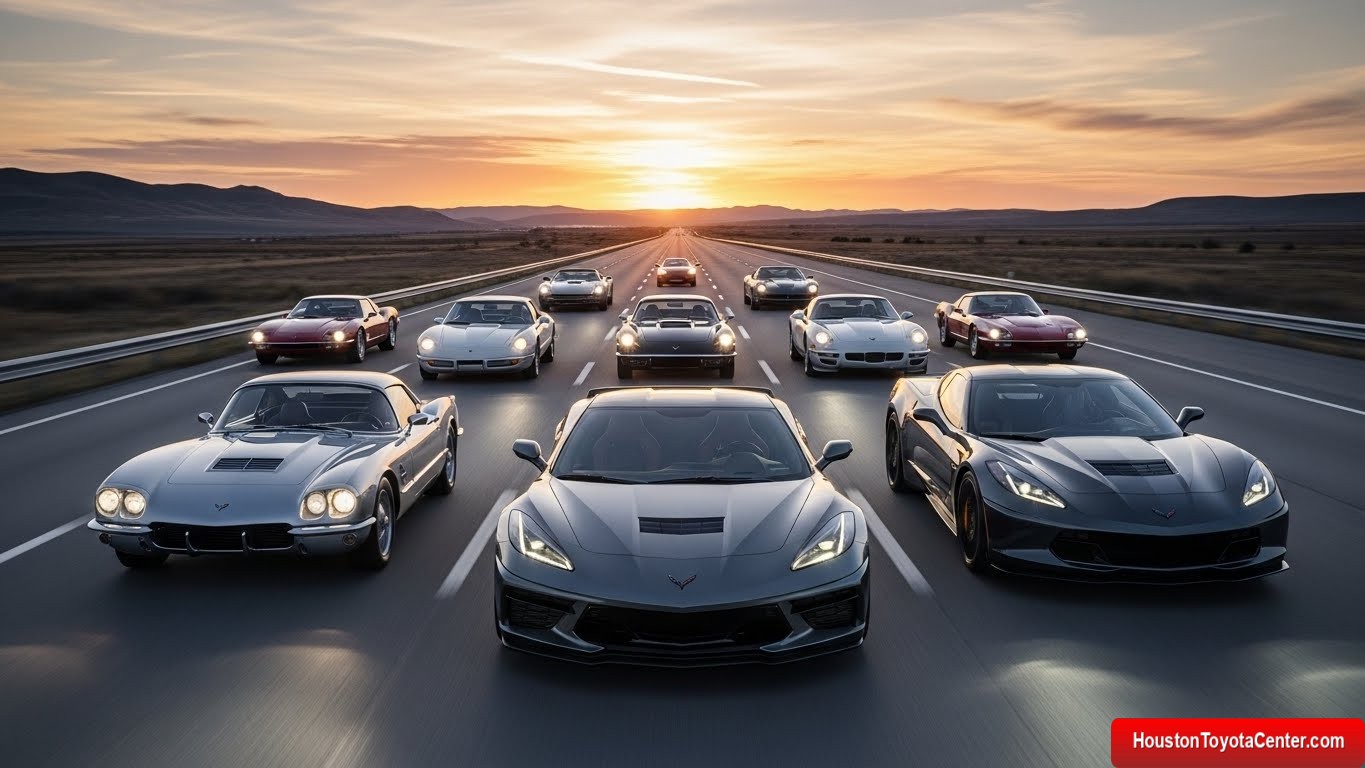
The Chevrolet Corvette is more than just a car. It is a cultural icon, a technological showcase, and a rolling symbol of American ambition. For over seven decades, the Corvette has represented the United States’ answer to the world’s greatest sports cars, evolving from a stylish roadster inspired by European designs into a world-class performance machine capable of rivaling the finest supercars on the planet.
From its fiberglass body and inline-six beginnings in the 1950s to its modern mid-engine layout and hybrid-assisted future, the Corvette’s story is one of constant reinvention while preserving a distinct identity. This article explores the Corvette’s journey through its generations, examining its engineering evolution, design philosophy, cultural impact, and why it continues to hold a special place in the hearts of enthusiasts worldwide.
The Birth of an American Sports Car (C1: 1953–1962)
A Bold Experiment
The Corvette debuted in 1953 at GM’s Motorama exhibition in New York City. At a time when American cars were largely focused on comfort, size, and straight-line cruising, the Corvette was something radically different. Inspired by lightweight European sports cars like Jaguar, MG, and Ferrari, Chevrolet aimed to create a stylish, nimble roadster that could ignite excitement among younger buyers.
Only 300 units were produced in the first year, all Polo White with red interiors. The body was made of fiberglass, a revolutionary choice that reduced weight and allowed more design flexibility. However, early Corvettes were underwhelming in performance, equipped with a modest inline-six engine and an automatic transmission.
FREE: Quickly identify and understand problems with your vehicle 🚘
CLICK HEREFinding Its Performance Soul
The Corvette’s true transformation began when Chevrolet introduced the small-block V8 in 1955. This single decision defined the Corvette’s future. The V8 delivered the performance American buyers craved, instantly elevating the Corvette from stylish novelty to legitimate sports car.
By the late 1950s, the Corvette had become faster, more refined, and increasingly competitive on racetracks. Racing legends like Zora Arkus-Duntov played a crucial role in pushing Chevrolet toward performance upgrades, high-output engines, and improved suspension.
C1 Highlights
| Feature | Details |
|---|---|
| Body Material | Fiberglass |
| Engine Evolution | Inline-6 → Small-block V8 |
| Transmission | Automatic → Manual options |
| Legacy | Established Corvette as a V8 sports car |
The C1 Corvette laid the foundation for everything that followed. It wasn’t perfect, but it was bold, ambitious, and unmistakably American.
The Sting Ray Era: Style Meets Substance (C2: 1963–1967)
A Design Revolution
The second-generation Corvette, known as the Sting Ray, remains one of the most celebrated designs in automotive history. Introduced in 1963, it featured sharp lines, aggressive proportions, and the iconic split rear window (available only in the first model year).
This generation marked a significant leap in engineering sophistication. Independent rear suspension dramatically improved handling, bringing the Corvette closer to European competitors in terms of road manners.
Performance Takes Center Stage
Big-block V8 engines became available, transforming the Corvette into a muscle-powered performance machine. The Sting Ray was as comfortable cruising highways as it was dominating drag strips and racetracks.
Chevrolet also began offering performance packages that catered to serious enthusiasts, including improved brakes, suspension tuning, and high-output engines.
Cultural Impact
The C2 Corvette captured the spirit of the 1960s: bold, rebellious, and unapologetically powerful. It became a symbol of freedom, speed, and American optimism, appearing in movies, television shows, and racing events worldwide.
Muscle, Excess, and Challenges (C3: 1968–1982)
A Long-Running Icon
The third-generation Corvette is notable for its unusually long production run. Inspired by the Mako Shark II concept, the C3 featured dramatic curves, flared fenders, and a cockpit-like interior.
Initially, performance continued to improve, with powerful big-block engines delivering thrilling acceleration. However, the 1970s brought significant challenges.
The Era of Regulation
New emissions standards, safety regulations, and fuel economy concerns drastically affected performance. Horsepower ratings dropped sharply, and by the mid-1970s, Corvettes were shadows of their former selves in straight-line speed.
Despite this, the Corvette survived when many performance cars disappeared. Chevrolet adapted by emphasizing comfort, luxury, and style, keeping the Corvette relevant even during difficult times.
Why the C3 Still Matters
The C3 maintained the Corvette’s presence during one of the automotive industry’s most turbulent periods. Its enduring popularity ensured the nameplate survived long enough to experience a performance renaissance.
Reinvention Through Technology (C4: 1984–1996)
A Clean Break from the Past
After skipping the 1983 model year, Chevrolet introduced the radically redesigned C4 Corvette in 1984. Everything about it felt modern: angular styling, digital dashboards, improved aerodynamics, and a focus on handling and balance.
The C4 was built on an entirely new platform, designed to handle higher performance while meeting modern safety standards.
Performance Returns
As technology improved, so did performance. Later C4 models featured powerful V8 engines, advanced suspension systems, and special high-performance variants like the ZR-1, which used a sophisticated DOHC V8 developed in collaboration with Lotus.
The ZR-1 proved that the Corvette could once again compete with the world’s best sports cars, offering supercar-level performance at a relatively attainable price.
The Global Competitor (C5: 1997–2004)
A World-Class Chassis
The C5 Corvette represented a turning point. Built on a hydroformed frame and powered by the all-new LS-series V8, the C5 combined reliability, power, and refinement like never before.
For the first time, the Corvette felt truly competitive on a global scale. Its balance, braking, and handling impressed critics worldwide.
Racing Dominance
Chevrolet committed heavily to motorsports during this era. The Corvette Racing program achieved significant success in endurance racing, particularly at Le Mans, cementing the Corvette’s reputation as a serious performance machine.
Why the C5 Matters
The C5 proved that the Corvette was no longer just “good for an American car.” It was simply good, period.
Refinement and Raw Power (C6: 2005–2013)
Sharper, Faster, Better
The sixth-generation Corvette refined everything the C5 introduced. It featured improved interior quality, sharper styling, and more powerful engines.
The legendary Z06 and ZR1 models pushed performance boundaries even further. Carbon fiber components, supercharged engines, and track-focused tuning made these Corvettes genuine supercar killers.
Affordability Meets Excellence
One of the Corvette’s enduring strengths is its value proposition. The C6 offered performance comparable to cars costing twice as much, reinforcing its reputation as the best performance bargain in the world.
Modern Technology and Everyday Usability (C7: 2014–2019)
A Bold New Identity
The C7 Corvette, branded as the Stingray once again, adopted aggressive styling and cutting-edge technology. Direct injection, advanced aerodynamics, and sophisticated electronics transformed the driving experience.
Inside, the Corvette finally offered a cabin that matched its performance, with premium materials, digital displays, and modern infotainment systems.
Track and Street Balance
Whether commuting or carving corners, the C7 excelled. High-performance variants like the Z06 and ZR1 delivered astonishing lap times while remaining street-legal.
A Radical Transformation: The Mid-Engine Era (C8: 2020–Present)
Breaking Tradition
The introduction of the mid-engine C8 Corvette marked the most radical change in the model’s history. Moving the engine behind the driver fundamentally altered the Corvette’s layout, performance characteristics, and global perception.
This decision was decades in the making, driven by the desire to maximize performance potential.
Supercar Performance, Corvette Price
The C8 delivers exotic-car performance at a fraction of the cost. Its balance, acceleration, and handling rival some of the most prestigious brands in the world.
The Future Is Hybrid and Electric
With hybrid variants already introduced and electric concepts on the horizon, the Corvette is poised to evolve once again, embracing new technologies while honoring its performance heritage.
Why the Corvette Endures
The Chevrolet Corvette’s longevity is not accidental. It survives because it adapts, innovates, and stays true to its mission: delivering thrilling performance that is accessible to passionate drivers.
It represents the American belief that performance should not be reserved for the elite. Each generation reflects the technological, cultural, and economic realities of its time while pushing boundaries forward.
Conclusion
From humble beginnings to mid-engine mastery, the Chevrolet Corvette tells the story of American automotive ambition. It has weathered economic downturns, regulatory challenges, and shifting consumer tastes, emerging stronger with each generation.
The Corvette is not just America’s sports car—it is America’s statement to the world that innovation, performance, and passion can coexist. As it moves into an electrified future, one thing remains certain: the Corvette’s spirit will continue to roar, evolve, and inspire generations to come.
Leave a Reply