
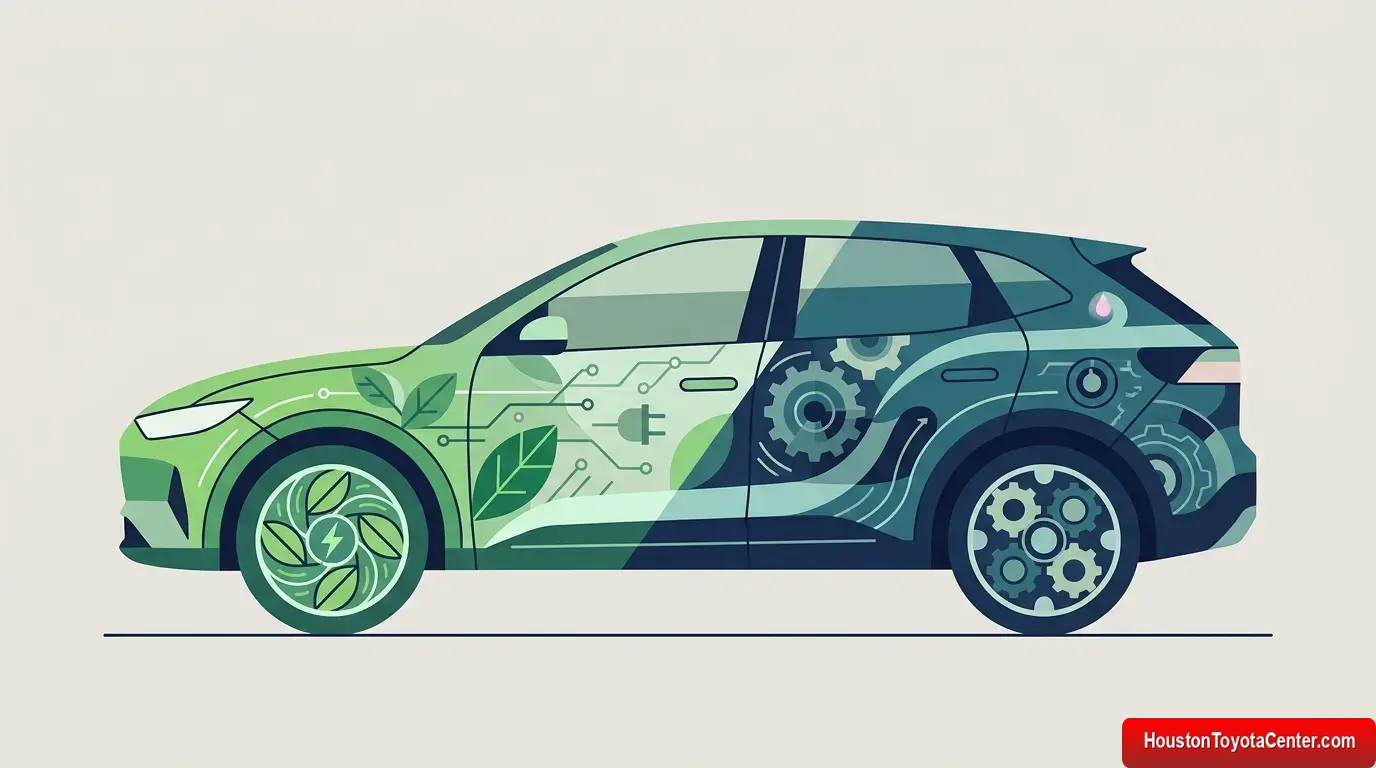
In the high-stakes world of modern automotive manufacturing, a fierce ideological battle is underway. On one side stand companies like Tesla and various traditional automakers that have pledged full allegiance to battery electric vehicles (BEVs). On the other stands Toyota, the world’s largest automaker by volume, leading a pragmatic, cautious, and often controversial resistance.
While competitors rush to announce deadlines for phased-out combustion engines, Toyota has steadfastly stuck to its “multi-pathway strategy.” This approach combines traditional internal combustion engines, hybrid electric vehicles (HEVs), plug-in hybrid electric vehicles (PHEVs), hydrogen fuel cells (FCEVs), and battery electric vehicles.
Is Toyota’s strategy a masterclass in long-term risk management, or is it a dangerous delay that risks leaving the corporate giant behind in an all-electric future?
🚗 The Foundations of the Multi-Pathway Philosophy
Toyota’s leadership has consistently argued that lithium-ion batteries are too resource-constrained and charging infrastructure too unevenly distributed globally to rely solely on BEVs. The core thesis rests on a simple calculation: maximizing carbon reduction with available battery materials today.
FREE: Quickly identify and understand problems with your vehicle 🚘
CLICK HEREInstead of putting a 100 kWh battery into a single long-range electric SUV, that same amount of battery material can power multiple smaller hybrid vehicles, replacing scores of purely gasoline-powered engines across the globe.
🔋 Battery Allocation Efficiency (1-6-90 Rule)
To explain this concept to regulators and investors, Toyota frequently references its internal resource allocation model, often called the 1-6-90 Rule:
- 1 Full Battery Electric Vehicle (BEV): Uses enough lithium, nickel, and cobalt for a single 100 kWh battery pack.
- 6 Plug-in Hybrid Electric Vehicles (PHEVs): Uses the same raw materials to create six ~16.6 kWh battery packs, reducing daily fuel consumption for six drivers.
- 90 Traditional Hybrid Vehicles (HEVs): Uses that exact same amount of raw material to equip 90 standard hybrid cars with ~1.1 kWh batteries, instantly reducing emissions across a massive fleet.
📊 Comparing Powertrain Technologies
To understand why Toyota continues to invest across every powertrain segment, it is essential to examine how each technology aligns with global market realities, cost structures, and infrastructure readiness.
| Powertrain Type | Battery Size | Grid Infrastructure Dependency | Target Market Realities | Toyota’s Strategic Stance |
| Traditional Hybrid (HEV) | Very Small (~1–2 kWh) | Zero (Self-charging via regenerative braking) | Global market; ideal for regions without charging grids | Primary Core: Mass production backbone worldwide |
| Plug-in Hybrid (PHEV) | Moderate (~13–20 kWh) | Low to Medium (Standard home wall outlet works) | Suburban commuters; zero range anxiety | Growth Focus: Extended range, near-zero local emissions |
| Battery Electric (BEV) | Large (~60–100+ kWh) | Critical (Requires fast DC charging networks) | Developed urban markets; home chargers available | Targeted Deployment: Scaled up gradually as grids adapt |
| Hydrogen Fuel Cell (FCEV) | Compact Buffer Pack | Special (Requires dedicated hydrogen stations) | Heavy transport, commercial fleets, long-distance trucks | Long-Term Pioneer: Targeted at commercial transport |
⚡ The Hybrid Advantage: Market Reality vs. Idealism
Consumer adoption patterns over the past few years have validated Toyota’s cautious stance in several major markets. While early adopters embraced purely electric vehicles, mainstream consumers continue to express concerns regarding price premiums, range anxiety, insurance costs, and public charging reliability.
Hybrids bridge this gap seamlessly. Drivers experience significant fuel savings and reduced emissions without changing their driving habits or relying on public charging networks.
       [ Gasoline Vehicle ]  --> High Emissions / Low Cost
                 │
                 ▼
       [ Toyota Hybrid (HEV) ] --> Low Emissions / Standard Refueling
                 │
                 ▼
       [ Plug-in Hybrid (PHEV) ] --> Ultra-Low Emissions / Home Charging
                 │
                 ▼
       [ Battery Electric (BEV) ] --> Zero Tailpipe / Total Grid Reliance
Key Consumer Benefits Driving Hybrid Demand
- Zero Range Anxiety: Long journeys require standard gas station stops lasting under five minutes.
- Lower Upfront Cost: Smaller battery packs keep vehicle purchase prices competitive without relying heavily on government subsidies.
- Resale Value and Reliability: Decades of proven nickel-metal hydride and lithium-ion hybrid tech mean lower long-term depreciation.
- Grid Independence: No stress on local electrical grids during peak hours or extreme weather events.
🏭 Manufacturing and Supply Chain Dynamics
By refusing to dismantle its internal combustion engine supply chains overnight, Toyota maintains stable employment, protects supplier networks, and keeps manufacturing plants flexible.
Toyota’s TNGA (Toyota New Global Architecture) platform was intentionally engineered to accommodate multiple powertrain variants on the exact same assembly lines. This allows factories to pivot production percentages between gasoline, hybrid, and plug-in models depending on real-time consumer demand shifts.
                  ┌─ Gasoline Models
                  │
[ TNGA Assembly ] ┼─ Hybrid Models (HEV)
                  │
                  └─ Plug-in Models (PHEV)
This flexibility stands in stark contrast to automakers that built dedicated EV mega-factories, leaving them vulnerable to severe financial losses whenever EV growth rates slow down or hit adoption plateaus.
🌍 The Global Disparity Problem
A central argument in Toyota’s global strategy is that the auto industry cannot design its global product lineup exclusively for wealthy metropolitan centers like California, Western Europe, or Eastern China.
In many developing nations across South America, Southeast Asia, Africa, and rural North America, electric grid stability remains unreliable, and high-speed DC charging networks are virtually non-existent.
Market Readiness Across Global Regions
- North America & Western Europe: EV infrastructure is expanding, but suburban and rural areas still favor hybrids for long-distance travel.
- China: Rapid BEV expansion driven by aggressive government mandates and strong domestic EV manufacturers.
- Southeast Asia & Latin America: Hybrid technology offers an immediate, scalable reduction in fossil fuel usage without requiring billions in grid overhauls.
By catering to all regions simultaneously, Toyota secures its profit margins in developing markets while gradually expanding its pure EV offerings in markets ready to support them.
🔬 Solid-State Batteries and Future Electrification
Toyota is not ignoring pure electric vehicles. The company is actively investing billions in next-generation battery technologies to overcome current limitations.
Toyota’s major technological gamble is Solid-State Batteries. Unlike conventional liquid-electrolyte lithium-ion batteries, solid-state designs offer higher energy density, faster charging times, and reduced fire risks.
Expected Performance Milestones for Toyota Solid-State BEVs
- Extended Range: Projected driving ranges exceeding 700 to 800 miles on a single charge.
- Rapid Charging: 10 to 80 percent charge times targeted under 10 minutes.
- Safety Profile: Non-flammable solid electrolytes reduce battery thermal runaway risks significantly.
By waiting for solid-state technology to mature rather than over-committing to current-generation liquid batteries, Toyota aims to leapfrog current EV market leaders once the technology reaches commercial scale.
⚖️ Strategic Risks and Critics’ Perspectives
Toyota’s approach is not without substantial risk. Critics, environmental group coalitions, and rival executives argue that the Japanese automaker is moving too slowly.
Primary Concerns Raised by Skeptics
- Regulatory Penalties: Stricter emissions standards in Europe and select American states could penalize automakers that do not meet strict zero-emission vehicle sales quotas.
- Brand Perception: Younger consumers may view Toyota as an environmental slow-mover compared to pure EV brands.
- Software Competence: Modern BEVs are defined by software architectures. Delaying mass BEV adoption could put Toyota behind in autonomous driving software and over-the-air update ecosystems.
Despite these criticisms, financial results consistently show strong operating margins and record earnings powered by global hybrid sales.
📌 The Road Ahead
The debate over the transition to clean mobility is rarely black and white. While pure electric vehicles will undoubtedly dominate many regional markets in the long run, Toyota’s pragmatic multi-pathway strategy acknowledges the messy, uneven nature of global technological transitions.
By balancing customer demand, battery material limitations, grid infrastructure constraints, and next-generation research, Toyota is playing a long game. Whether history remembers this strategy as cautious wisdom or stubborn hesitation, one reality remains clear: Toyota’s hybrids are keeping the company exceptionally profitable while the rest of the industry navigates the turbulent electrification transition.
Leave a Reply