
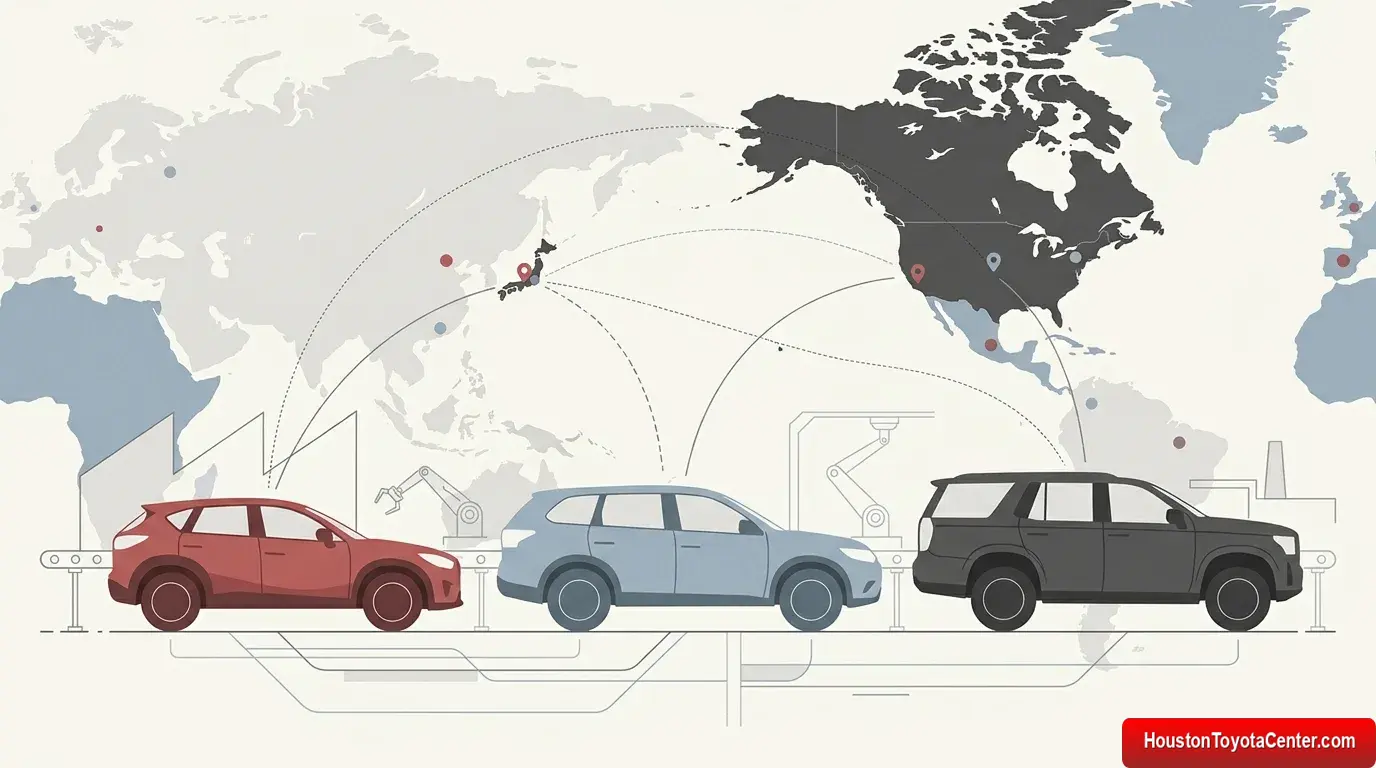
From American assembly lines to Japanese factories and Canadian manufacturing plants, Toyota builds its SUVs across a global production network designed to serve regional markets. Understanding where popular models are manufactured can help buyers make sense of vehicle origins, supply chains, and the differences between cars sold under the same name.
Toyota’s Global SUV Manufacturing Strategy
Toyota is one of the world’s largest automotive manufacturers, with production operations spanning multiple continents. Although the company is headquartered in Japan, many Toyota vehicles sold around the world are assembled much closer to their intended customers.
This approach is particularly important in the sport utility vehicle market. Models such as the RAV4, Highlander, Grand Highlander, 4Runner, and Sequoia serve different audiences, and their manufacturing locations reflect regional demand, production capacity, and the availability of specialized facilities.
For buyers, the answer to a seemingly simple question, such as where a Toyota SUV is made, can be more complicated than expected. A model name does not necessarily identify a single factory or even a single country of origin.
FREE: Quickly identify and understand problems with your vehicle 🚘
CLICK HEREThe same SUV may be assembled in different countries depending on the destination market, production year, powertrain, or manufacturing allocation. A vehicle sold in the United States may have a different assembly origin from a similarly named vehicle sold in Europe, Asia, or Latin America.
Toyota’s official global manufacturing directory identifies production sites and their principal products. Its North American facilities include factories in the United States, Canada, and Mexico, with different locations specializing in different vehicles and components.
This network illustrates how modern automotive manufacturing works. Rather than relying exclusively on a single domestic factory, Toyota distributes production across multiple locations to support a wide range of customers and vehicle configurations.
The United States: A Major Hub for Toyota SUVs
The United States plays a central role in Toyota’s SUV manufacturing strategy. Several popular models sold in the American market are assembled domestically, supporting local employment and reducing the need to import every finished vehicle.
One of the most important locations is Toyota Motor Manufacturing Indiana, based in Princeton, Indiana. The plant produces the Toyota Highlander, Grand Highlander, and related hybrid versions, alongside the Lexus TX. It is an important production center for three row SUVs designed for family transportation.
The Highlander and Grand Highlander serve different roles within Toyota’s lineup. The Highlander is positioned as a midsize family SUV, while the Grand Highlander offers additional interior space for buyers who need more room for passengers and luggage.
Producing these vehicles in Indiana allows Toyota to manufacture a significant portion of its American family SUV lineup within the country. It also creates a regional manufacturing base for vehicles that appeal to buyers seeking three rows of seating, modern technology, and everyday practicality.
Another important facility is Toyota Motor Manufacturing Kentucky, located in Georgetown. The factory has historically been associated with Camry production and now also produces the RAV4 Hybrid. Toyota announced that RAV4 Hybrid assembly began at the Kentucky facility in June 2026, adding another domestically produced model to its American manufacturing portfolio.
Texas is another major production location. Toyota Motor Manufacturing Texas, in San Antonio, assembles the Tundra and Sequoia, including hybrid versions of these vehicles. The Sequoia occupies the larger end of Toyota’s SUV range, making its production location particularly relevant to buyers interested in full size family vehicles.
Together, these factories demonstrate that Toyota’s American SUV lineup is not dependent on one assembly plant. Different facilities focus on particular models, powertrains, and manufacturing requirements.
Where Is the Toyota RAV4 Built?
The Toyota RAV4 is one of the company’s most recognizable SUVs, and its production history demonstrates why buyers should not assume that every example comes from the same country.
Toyota’s North American manufacturing directory lists RAV4 production in Canada and the United States. The company also lists the RAV4 among the vehicles produced at its Japanese facilities. The precise origin of an individual vehicle therefore depends on the market, model year, and manufacturing allocation.
In Canada, Toyota Motor Manufacturing Canada operates in Ontario, with major manufacturing operations in Cambridge and Woodstock. The company identifies the RAV4, including hybrid versions, among the vehicles assembled at its Canadian facilities.
In the United States, Toyota’s Kentucky factory has expanded its role by adding RAV4 Hybrid production. Japan remains another important production base within Toyota’s global network.
These multiple manufacturing locations offer practical advantages. They allow Toyota to distribute production, serve different markets, and adjust its manufacturing arrangements as demand changes.
The RAV4 has also become increasingly important to Toyota’s electrification strategy. Hybrid and plug in hybrid configurations require different components from conventional gasoline vehicles, including specialized electrical systems and battery packs.
Manufacturing facilities must therefore coordinate vehicle assembly with the supply of batteries, motors, engines, transmissions, and other components.
For shoppers, the most reliable way to determine where a particular RAV4 was built is to check its vehicle identification number, or VIN, and the manufacturer’s labeling. The country of assembly should be verified for the individual vehicle rather than inferred from the model name alone.
Toyota Highlander and Grand Highlander: Indiana Production
Toyota’s Indiana factory is particularly important for buyers researching where its three row SUVs are manufactured.
The plant assembles the Highlander, Highlander Hybrid, Grand Highlander, and Grand Highlander Hybrid, according to Toyota’s official North American manufacturing information.
Although their names are similar, the Highlander and Grand Highlander serve somewhat different purposes.
The Highlander is designed for families who want three row seating in a relatively manageable package. The Grand Highlander targets buyers who need more generous passenger accommodation and luggage capacity, particularly when all three rows are in use.
Producing both vehicles at the same Indiana facility allows Toyota to use a shared regional manufacturing base while offering customers different sizes and configurations.
Hybrid versions add another layer of complexity. Hybrid vehicles combine conventional engine technology with electric motors, power electronics, and battery systems. Their assembly requires coordination between mechanical and electrical components, along with the quality controls associated with electrified vehicles.
The Indiana operation is therefore not simply a conventional assembly plant producing one vehicle type. It is part of a broader manufacturing system that supports multiple models and powertrain configurations.
For American shoppers, the factory’s location is also a reminder that buying a Toyota SUV does not necessarily mean buying a vehicle assembled in Japan. Many popular Toyota models have long been produced in North America.
Toyota Sequoia: Built in Texas
The Toyota Sequoia occupies a different position in the SUV market. It is a full size SUV intended for buyers who need substantial passenger space, strong towing capability, and the ability to carry families and equipment over longer distances.
Toyota assembles the Sequoia at its San Antonio, Texas, manufacturing facility. The plant also produces the Tundra pickup truck, including hybrid versions of that model.
The connection between the Sequoia and Tundra reflects their shared place in Toyota’s larger vehicle portfolio. Both are built around the needs of drivers who want a more substantial vehicle than a compact or midsize crossover.
The Texas facility is an important example of regional specialization. Rather than distributing every model evenly across all factories, Toyota assigns particular vehicles to facilities equipped to manufacture them efficiently.
The Sequoia’s Texas assembly origin may be of interest to buyers researching domestic manufacturing, although country of assembly alone does not determine overall vehicle quality, durability, or reliability.
Those characteristics also depend on engineering, supplier standards, production processes, maintenance, and the condition of the individual vehicle.
Mexico: An Important Part of Toyota’s Supply Chain
Mexico also plays a significant role in Toyota’s North American manufacturing network. Toyota Motor Manufacturing de Baja California, located in Baja California, and Toyota Motor Manufacturing de Guanajuato are among the company’s Mexican manufacturing operations.
Toyota’s official directory lists Tacoma production at these facilities, including hybrid production at Guanajuato. These are pickup truck operations rather than evidence that every Toyota SUV is manufactured in Mexico.
This distinction matters because automotive manufacturing networks often combine vehicles and components from several countries. A factory may assemble a finished vehicle, manufacture an engine, or produce specialized parts that are shipped to another facility.
The growing importance of Mexico in North American automotive production reflects the integration of manufacturing across the region. Suppliers, assembly plants, logistics providers, and distribution networks operate across national borders.
For consumers, the lesson is straightforward: the presence of a Toyota manufacturing facility in a country does not automatically mean that every popular Toyota model is assembled there.
Model specific information is essential when determining the origin of an SUV.
Japan: The Home of Toyota’s Manufacturing Heritage
Japan remains central to Toyota’s identity and manufacturing operations. The company maintains a broad network of production facilities across the country, with different plants specializing in vehicles, engines, hybrid components, and other automotive systems.
Toyota’s official global manufacturing directory lists the RAV4 among the products associated with Japanese production sites. It also identifies the Tsutsumi plant with vehicles such as the Prius, Corolla, and several Crown models.
Japanese factories have long been associated with Toyota’s manufacturing philosophy, including continuous improvement, standardized work, quality control, and efficient production processes.
These principles are often discussed under the broader umbrella of the Toyota Production System. The system emphasizes identifying problems, reducing unnecessary activities, and improving processes over time.
However, Toyota’s manufacturing philosophy is not limited to Japan. The company applies production standards across its global operations, adapting facilities and processes to regional requirements while maintaining common expectations for quality.
A Toyota SUV assembled in Indiana or Canada is not automatically less authentic than one assembled in Japan. Its origin reflects Toyota’s international manufacturing strategy rather than a simple ranking of quality.
The Next Chapter: Electrification and New Manufacturing Investments
Toyota’s manufacturing network continues to evolve as consumer demand, environmental regulations, and powertrain technology change.
Hybrid vehicles have become a central part of the company’s strategy, and Toyota has expanded production capacity for hybrid engines, batteries, and complete vehicles. Its North American manufacturing directory identifies facilities dedicated to vehicle assembly as well as operations that produce engines, transmissions, and other components.
Toyota’s battery manufacturing operation in North Carolina began assembling hybrid vehicle batteries at the end of 2025, according to the company’s October 2026 manufacturing update. The facility adds another important element to the regional supply chain for electrified vehicles.
The company has also announced plans for additional investment in American manufacturing. Such investments can involve new production lines, factory expansions, equipment upgrades, and the development of manufacturing capabilities for future models.
These changes are significant because the shift toward electrification affects more than the vehicle assembly line. Manufacturers must also coordinate battery production, electronics, powertrain components, software integration, and supplier relationships.
Toyota’s manufacturing strategy therefore involves more than deciding which factory should build a particular SUV. It requires long term planning across the entire production network.
Where Is the New Electric Toyota Highlander Built?
The Highlander name is also entering a new phase as Toyota expands its electric vehicle lineup.
Toyota has announced an all electric Highlander for the US market, with production planned at its Georgetown, Kentucky, manufacturing facility and batteries produced in North Carolina. The electric model represents a major change from the gasoline and hybrid Highlander versions associated with Indiana production.
This development highlights an important point for consumers researching model origins. A familiar nameplate can change its manufacturing location when the vehicle’s design and powertrain change significantly.
The electric Highlander’s production plan also illustrates the growing relationship between vehicle assembly and battery manufacturing. Battery production is a specialized operation that requires different equipment, processes, and supply arrangements from conventional engine manufacturing.
Because production schedules and market launches can change, buyers should verify the latest manufacturer announcements when researching a newly introduced model. A planned manufacturing location should not be confused with a facility already producing vehicles for retail delivery.
Does the Country of Assembly Affect Quality?
For many buyers, the question of where a Toyota SUV is built is closely connected to concerns about quality and reliability.
Country of assembly can provide useful information about a vehicle’s origin, but it is not a reliable standalone measure of quality.
Toyota uses manufacturing standards, supplier requirements, inspection procedures, and quality management systems across its international operations. Individual factories may specialize in different models and components, but vehicles are expected to meet the relevant engineering and safety requirements.
Reliability also depends on the specific model generation, powertrain, maintenance history, driving conditions, and how the vehicle has been used.
A well maintained SUV assembled in North America may prove more dependable than a poorly maintained vehicle assembled elsewhere. Similarly, a new model can experience early production issues regardless of its country of origin.
Buyers comparing used Toyota SUVs should prioritize service records, recalls, inspection results, mileage, and vehicle condition rather than assuming that one country automatically produces a better vehicle.
For new vehicle shoppers, warranty coverage, dealer support, available parts, and the suitability of the vehicle for their needs are also important considerations.
How to Find Where Your Toyota SUV Was Made
Consumers who want to identify the manufacturing origin of a particular vehicle can begin with the VIN.
The VIN is a unique vehicle identifier that can provide information about a vehicle’s manufacturer and production characteristics. The exact information encoded varies, and the VIN should be interpreted using authoritative manufacturer or government resources.
The vehicle certification label and other factory documentation may also identify the country of manufacture or final assembly. Buyers can ask a Toyota dealer to confirm the origin of a specific vehicle using its VIN and production records.
This approach is more reliable than relying on general online lists because manufacturing allocations can change between model years.
It is also useful to distinguish the country where a vehicle is assembled from the origins of its components. An SUV assembled in the United States may contain parts manufactured in Japan, Canada, Mexico, and other countries.
Modern vehicles are international products, and final assembly is only one stage of their manufacturing process.
Final Thoughts: Toyota’s SUVs Are Built Around the World
Toyota’s SUV manufacturing network extends well beyond Japan. The United States assembles important models such as the Highlander, Grand Highlander, and Sequoia, while RAV4 production is distributed across North American and Japanese facilities. Canada and Mexico also contribute to the wider manufacturing system, particularly through vehicle and component production.
These arrangements allow Toyota to serve different markets, support regional demand, and coordinate the production of gasoline, hybrid, and future electric vehicles.
For buyers, understanding where a particular SUV is built can provide useful context about its origin, but it should not be treated as a substitute for evaluating quality, safety, reliability, or ownership costs.
The most accurate answer always begins with the specific model, model year, destination market, and vehicle identification number.
Toyota’s global reach means that an SUV wearing the same badge may come from different factories around the world. Knowing where your vehicle was assembled is the first step toward understanding the manufacturing network behind it.
Leave a Reply