
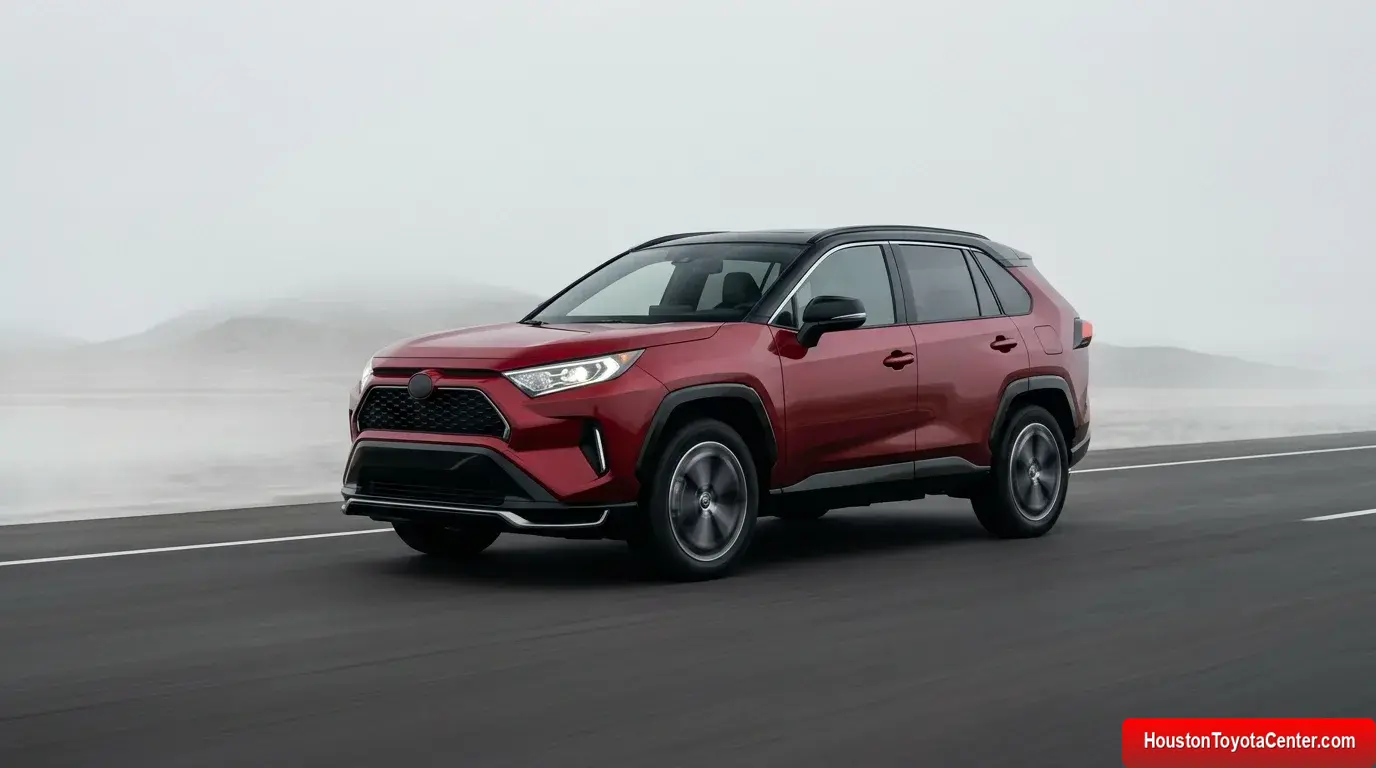
The Toyota RAV4 has long been associated with practicality, reliability, and everyday usability. It is the kind of SUV designed to make life easier rather than more exciting. Yet the RAV4 Prime changed that perception dramatically. By combining a gasoline engine with a powerful plug-in hybrid system and all-wheel drive, Toyota created one of the quickest vehicles in its mainstream SUV lineup.
The result is a compact crossover that can deliver genuinely brisk acceleration while still functioning as an efficient commuter. It can run on electricity for short daily trips, operate as a conventional hybrid when the battery is depleted, and provide all-wheel-drive traction when conditions become challenging.
That unusual combination is what makes the RAV4 Prime so interesting. It is not a sports car disguised as an SUV, nor is it simply an economical family vehicle with a large battery. Instead, it occupies a middle ground where performance and efficiency coexist.
A Powertrain That Changes the Character of the RAV4
At the heart of the RAV4 Prime is a 2.5-liter four-cylinder gasoline engine working with electric motors and a relatively large lithium-ion battery pack. The system produces 302 net combined horsepower, making the plug-in RAV4 considerably more powerful than the conventional RAV4 Hybrid.
FREE: Quickly identify and understand problems with your vehicle 🚘
CLICK HEREThe difference is immediately noticeable from behind the wheel.
Press the accelerator from a standstill and the electric motors deliver instant torque, giving the RAV4 Prime a surprisingly forceful launch. There is no need to wait for a turbocharger to build boost or for the engine to climb through the rev range. The electric motors provide their response immediately, and the gasoline engine joins the effort as necessary.
Toyota rates the RAV4 Prime at 0 to 60 mph in approximately 5.5 seconds for the 2025 model year. Earlier independent testing by Car and Driver recorded an even quicker 5.4-second sprint, demonstrating that this family-oriented crossover is capable of acceleration that was once reserved for performance-oriented cars.
That number tells only part of the story.
What makes the RAV4 Prime feel fast is not simply its stopwatch performance. It is the immediacy of the power delivery. Electric assistance fills in the gaps where a traditional gasoline engine would normally need time to respond, creating strong acceleration with remarkably little drama.
The Surprise Factor
The RAV4 Prime’s performance is particularly impressive because the vehicle does not look like a performance machine.
Its upright proportions, practical cabin, generous ground clearance, and SUV body shape make it look much more like a conventional family crossover. There are sporty details, particularly on the XSE trim, but the overall design does not advertise the performance available underneath.
That creates a certain element of surprise.
A driver can leave home in near-silent electric operation, drive through city traffic without using gasoline, and then access substantial acceleration when entering a highway. The same vehicle can also carry passengers, luggage, and everyday cargo without requiring the compromises associated with a dedicated performance vehicle.
Toyota quotes up to 42 miles of electric-only range for the 2025 RAV4 Plug-in Hybrid, while its hybrid operation is rated at an estimated 38 mpg combined by the manufacturer.
For many owners, that combination could mean that the majority of routine commuting happens without gasoline.
Electric Power Makes City Driving Better
The RAV4 Prime’s electric capability is not merely an efficiency feature. It also changes the driving experience.
Electric propulsion is particularly well suited to urban environments. The vehicle can move away from traffic lights smoothly and quietly, and the absence of constant engine operation makes low-speed driving feel more relaxed.
The transition between electric and gasoline operation is generally designed to be seamless. When additional power is required, the gasoline engine can come online without fundamentally changing the character of the vehicle.
This flexibility is one of the strongest arguments for choosing a plug-in hybrid over either a conventional gasoline SUV or a traditional hybrid.
Drivers who have access to home charging can use the battery for short trips and commuting, while longer journeys do not require the careful route planning associated with a battery-electric vehicle.
Once the battery is depleted, the RAV4 Prime does not become a stranded electric vehicle. It simply continues operating as a hybrid.
That versatility remains one of the model’s greatest strengths.
All-Wheel Drive Comes Standard
Performance is also helped by the RAV4 Prime’s electronic all-wheel-drive system. Rather than relying on a traditional mechanical driveshaft connecting the front and rear axles, the rear wheels are powered by a separate electric motor.
This arrangement has several advantages.
The system can respond quickly when additional traction is required. It can also contribute to stability during acceleration and cornering. In low-grip conditions, the electric rear motor gives the vehicle another tool for managing traction.
The system is not designed to transform the RAV4 Prime into a serious off-road machine, but it adds useful capability for rain, snow, gravel roads, steep driveways, and other situations where front-wheel drive alone might struggle.
Toyota also provides a Trail mode. The system can use braking and power distribution to help control wheelspin, effectively simulating the behavior of a limited-slip differential in certain situations.
For an everyday crossover, that is a useful level of sophistication.
Fast, But Not a Sports SUV
Despite its impressive acceleration, the RAV4 Prime has an important limitation: its performance story is much stronger in a straight line than in corners.
This is still a relatively heavy compact SUV. Independent testing of the earlier RAV4 Prime found a curb weight of roughly 4,400 pounds, significantly more than the conventional hybrid.
That extra mass comes from the larger battery and associated hardware.
As a result, the RAV4 Prime can accelerate with genuine enthusiasm, but it does not suddenly become a sports car when the road begins to twist. Steering, braking, body control, and tire grip remain tuned primarily for everyday usability.
That is not necessarily a criticism.
The RAV4 Prime’s appeal comes from its balance. Toyota did not attempt to turn it into a track-oriented crossover. Instead, the company created a vehicle that can be efficient and comfortable most of the time, while offering an unexpected reserve of acceleration whenever the driver wants it.
Sport Mode Adds Some Character
Toyota provides multiple drive modes, including Eco and Sport. Sport mode adjusts the vehicle’s response to make acceleration and steering feel more immediate.
It does not radically transform the vehicle, but it reinforces the RAV4 Prime’s dual personality.
In Eco mode, the SUV feels calm and deliberate. The system prioritizes smoothness and efficiency, making it easy to drive gently through traffic.
Sport mode changes the emphasis. Accelerator response becomes more assertive, and the hybrid system is prepared to deliver stronger performance when the driver demands it.
The distinction is useful because the RAV4 Prime does not need to be driven aggressively to be enjoyable. Its strongest quality is that the performance is available when needed, without forcing the driver to live with an unnecessarily aggressive vehicle every day.
Charging Is a Major Part of the Experience
Owning a plug-in hybrid requires a slightly different mindset from owning a conventional hybrid.
The RAV4 Prime can be charged using a standard 120-volt household outlet, although charging is considerably faster with a Level 2 connection. Toyota says a standard household outlet can take about 12 hours under its stated conditions, while a Level 2 charger can reduce that time to roughly two and a half hours.
For owners with overnight access to charging, this can make the vehicle particularly compelling.
Plug it in after work, wake up with a full battery, and the next morning’s commute can potentially be completed primarily on electric power.
But if charging is unavailable, the vehicle remains fully functional. That is an important advantage over a battery-electric vehicle for drivers who frequently travel long distances or live in areas where charging infrastructure is less convenient.
Everyday Practicality Remains Intact
Performance would mean little if the RAV4 Prime sacrificed the practicality that made the RAV4 successful in the first place.
Toyota maintains seating for five and offers useful cargo capacity. The battery is positioned under the vehicle floor, which helps preserve passenger space and contributes to a lower center of gravity. Toyota lists 33.5 cubic feet of cargo volume behind the rear seats for the 2025 model.
That makes the RAV4 Prime a relatively easy vehicle to live with.
It can serve as a commuter during the week, a family vehicle on weekends, and a long-distance road-trip machine without requiring owners to maintain a separate vehicle for different purposes.
This versatility is arguably more important than its acceleration figure.
The Trade-Offs
No plug-in hybrid is perfect, and the RAV4 Prime has several compromises.
First, the additional battery hardware makes the vehicle heavier than a standard RAV4 Hybrid. That weight affects handling and efficiency once the vehicle is operating outside its ideal conditions.
Second, the price is significantly higher than that of a conventional RAV4. Toyota’s 2025 RAV4 Plug-in Hybrid started at $43,865 according to the company’s initial announcement, before applicable dealer fees, with higher trims costing more.
Third, the technology is impressive but the RAV4 Prime’s driving experience is not completely performance-focused. Buyers expecting sharp handling, aggressive brakes, and sports-car-like feedback may find the vehicle too conservative.
Finally, the infotainment and cabin experience of the fifth-generation RAV4 platform began to show its age compared with newer competitors and newer Toyota products.
The vehicle’s strengths are therefore concentrated in its powertrain rather than in every aspect of its design.
Is the RAV4 Prime Still Worth Considering?
The answer depends largely on how it will be used.
For a driver who has access to home charging and regularly travels relatively short distances, the RAV4 Prime makes an unusually strong case. Electric commuting can reduce gasoline consumption while the gasoline engine remains available for longer journeys.
For someone who values acceleration, the argument becomes even stronger. With 302 horsepower and a manufacturer-rated 5.5-second 0-to-60 mph time, the RAV4 Prime delivers performance that is unusual in a practical compact SUV.
But shoppers should also understand the model’s position in Toyota’s lineup.
For 2025, Toyota renamed the vehicle the RAV4 Plug-in Hybrid, retaining the fundamental powertrain concept. More importantly, Toyota subsequently introduced an all-new sixth-generation RAV4 for the 2026 model year, with a new-generation plug-in hybrid system and up to 320 horsepower in certain configurations.
That means the fifth-generation RAV4 Prime represents the end of an important chapter in Toyota’s plug-in hybrid development.
Final Verdict
The RAV4 Prime is one of those vehicles that becomes more impressive the longer you consider what it is actually capable of doing.
It is a compact SUV with seating for five, useful cargo space, all-wheel drive, plug-in capability, hybrid efficiency, and enough electric assistance to produce sports-car-like acceleration in the right conditions.
It does not handle like a sports car. It does not sound like one. It does not look like one.
And that is precisely the point.
The RAV4 Prime’s greatest achievement is combining conflicting priorities into a single vehicle. It can be quiet and efficient in the morning, practical during the afternoon, and surprisingly quick when the road opens up.
For drivers who want the flexibility of a gasoline-powered road-trip vehicle without giving up the advantages of electric driving, that combination remains difficult to ignore.
The RAV4 Prime may never be remembered as Toyota’s most exciting performance vehicle. But it deserves recognition as one of the company’s most convincing demonstrations of how electrification can make an ordinary SUV significantly more capable.
Performance: 9/10
Efficiency: 9/10
Everyday usability: 9/10
Handling: 7/10
Value: 8/10
Overall: 8.5/10
The most impressive thing about the RAV4 Prime is not that it is fast. It is that Toyota managed to make speed just one part of a much broader package.
Leave a Reply