
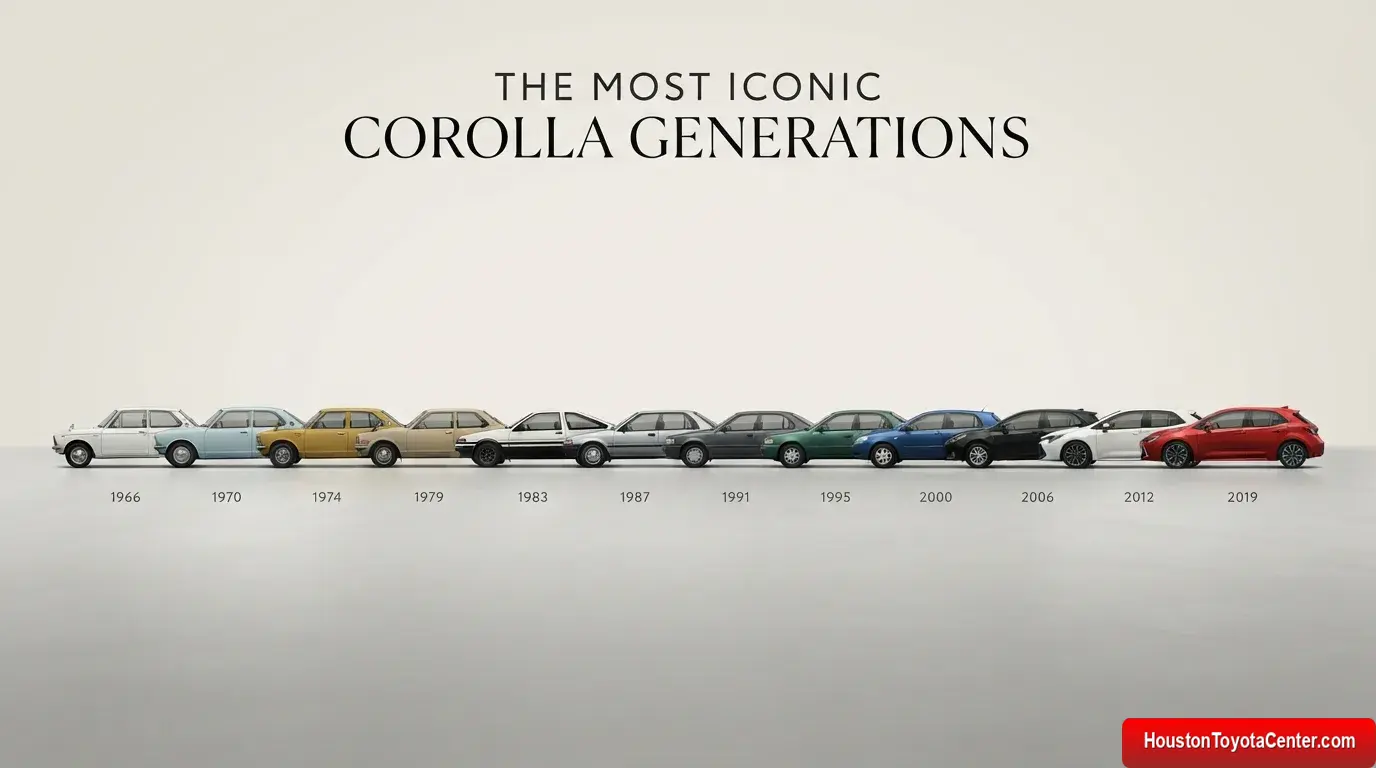
Few cars have remained as relevant across decades as the Toyota Corolla. Introduced in Japan in 1966, the compact family car was created at a moment when private automobile ownership was rapidly expanding and Japanese consumers were beginning to demand more from affordable cars. Nearly six decades later, the Corolla has evolved through twelve generations, adapting its design, technology and character to changing markets while retaining the name that made it one of the most recognizable vehicles in automotive history.
The Corolla’s story is not simply about sales numbers. It is also a story about how the automobile changed from a relatively simple form of transportation into a global cultural object. Some generations became famous for their practicality and durability. Others gained attention because of their styling, engineering or connection to motorsport and enthusiast culture.
Looking back across the history of the nameplate, several generations stand out as particularly influential and memorable.
1966: The Beginning of the Corolla Era
The first-generation Corolla arrived in November 1966 as a compact five-seat sedan positioned between the Publica and Corona in Toyota’s lineup. Toyota developed the car around what it described as an “80 points plus alpha” philosophy, aiming to deliver a balanced combination of performance, quality, economy and comfort rather than focusing on one characteristic alone.
FREE: Quickly identify and understand problems with your vehicle 🚘
CLICK HEREIts timing was crucial. Japan was experiencing rapid economic growth, highway infrastructure was expanding and private car ownership was becoming increasingly accessible. Toyota recognized that consumers wanted a family car that offered more than basic transportation. The Corolla was designed to answer that demand.
The original model was compact, but it was not deliberately primitive. Toyota gave it features intended to make everyday driving more comfortable and capable, helping establish a formula that would become central to the Corolla identity.
The first generation also established the name internationally. Production outside Japan began in Malaysia and Australia in 1968, while exports to the United States started that same year.
That global expansion would eventually become one of the defining characteristics of the Corolla. It was no longer simply a Japanese family car. It was becoming a worldwide product.
The Second and Third Generations: Growing With the Market
The second-generation Corolla arrived in 1970, after the first generation had already surpassed one million units in production. Toyota increased the car’s size and improved its driving performance while retaining the basic formula that had made the original successful.
This generation also helped broaden the Corolla’s personality. The model was no longer limited to being a practical family sedan. Toyota developed versions with a stronger sporting character, reflecting the growing interest in performance-oriented compact cars.
The third generation followed in 1974. By this point, the Corolla was firmly established as a major international model. Its evolution reflected a broader trend in the automotive industry, as manufacturers increasingly had to balance performance, economy, safety and emissions requirements.
The Corolla’s ability to change without abandoning its fundamental purpose became one of its greatest strengths.
The Fourth Generation: A New Design Direction
Introduced in 1979, the fourth-generation Corolla represented another important step in the model’s development. Its styling became more angular and sophisticated, reflecting the design language of the late 1970s and early 1980s.
The Corolla was becoming more than an economical family vehicle. Different body styles and markets gave buyers considerably more choice, while Toyota continued to refine the car’s engineering.
This generation is particularly interesting because it sits at the transition between the traditional rear-wheel-drive compact era and the front-wheel-drive future that would soon reshape the segment.
That transition would become especially significant with the next generation.
The Fifth Generation and the Birth of the AE86 Legend
If one Corolla generation has achieved an especially strong reputation among enthusiasts, it is the fifth generation.
Introduced in 1983, the fifth-generation Corolla represented a major technical change. Toyota moved the mainstream Corolla lineup toward front-wheel drive, reflecting the industry’s growing interest in packaging efficiency and interior space. At the same time, Toyota retained rear-wheel-drive configurations for certain sporty models.
This is where the legendary AE86 enters the story.
The Corolla Levin and Sprinter Trueno versions became associated with lightweight construction, rear-wheel drive and responsive handling. Today, the AE86 is recognized far beyond the traditional Corolla audience. Its reputation was strengthened by motorsport, drifting culture and popular media, turning what began as a relatively affordable compact sports car into an enthusiast icon.
Toyota’s own historical material identifies the fifth generation as the 1983 model, while Toyota’s U.S. historical archive lists North American versions from 1984 to 1987.
The AE86 demonstrates something unusual about the Corolla. A model created primarily as an affordable compact could develop an entirely different identity among enthusiasts decades later.
Its influence also illustrates how important mechanical simplicity and driver involvement can become when a car is placed in the right cultural context.
The Sixth Generation: The Corolla Becomes More Mature
The sixth generation arrived in 1987 and continued the transformation of the Corolla into a more refined global compact.
By the late 1980s, buyers increasingly expected compact cars to provide greater comfort, better technology and improved safety without sacrificing affordability. Toyota responded with a Corolla that was more mature in both appearance and engineering.
The generation also marked an important period in the international expansion of Toyota’s product strategy. The Corolla name remained consistent, but regional versions could differ significantly in body styles, engines and equipment.
This global adaptability was becoming essential. Toyota was no longer designing the Corolla solely around the needs of Japanese consumers. It was developing a worldwide family of vehicles that could be adapted to different markets.
The Seventh Generation: The Peak of the Traditional Sedan
The seventh-generation Corolla, introduced in Japan in 1991, represents another particularly memorable point in the model’s history.
Toyota increased the wheelbase and overall dimensions, giving the car a more substantial appearance. The company described this generation as the culmination of a long trend toward making the Corolla feel more upscale while maintaining its accessible positioning.
The result was a Corolla that looked considerably more substantial than its early predecessors.
The early 1990s were also a fascinating period for Japanese automotive engineering. Manufacturers were producing increasingly sophisticated engines, suspension systems and electronic equipment, and the Corolla benefited from that environment.
In enthusiast circles, the era is remembered for models such as the high-performance Corolla variants equipped with Toyota’s celebrated four-cylinder engines. Meanwhile, ordinary Corolla sedans continued to focus on reliability, practicality and everyday usability.
That combination of ordinary transportation and enthusiast appeal became one of the Corolla’s defining contradictions.
The Eighth Generation: Technology Meets Efficiency
The eighth generation arrived in 1995 and reflected a changing automotive landscape. Toyota emphasized environmental considerations, safety and total cost of ownership during development. The company also reduced vehicle weight by as much as 50 kilograms compared with the previous generation while introducing increasingly sophisticated engines.
Among the most notable technical developments was the availability of a 1.6-liter five-valve VVT engine in the Japanese market lineup, alongside several other engines.
By the mid-1990s, the Corolla had become a highly mature product. The basic concept remained recognizable, but the technology behind it was considerably more advanced than that of the original 1966 car.
The transformation was remarkable. The Corolla had gone from a simple compact sedan associated with Japan’s motorization boom to a sophisticated global vehicle capable of meeting increasingly complex consumer and regulatory expectations.
The Ninth Through Eleventh Generations: The Global Corolla
The ninth generation arrived in 2000, followed by the tenth generation in 2006 and the eleventh in 2012. Toyota’s global gallery identifies these as the ninth, tenth and eleventh generations respectively.
During this period, the Corolla increasingly became a symbol of mainstream global transportation.
The styling changed substantially from one generation to the next, but the fundamental priorities remained familiar: efficiency, practicality, affordability and durability.
This period also illustrates why defining a single “Corolla” can be difficult. Toyota sold different versions under the same name in different markets, with regional differences in body design, engines, equipment and even generation timing.
The European, Japanese and North American Corollas did not always follow identical timelines. Toyota’s historical gallery, for example, shows different production periods for the same generation depending on the market.
That regional variation is an important part of the Corolla story. The name became global, but the product was never completely identical everywhere.
The Twelfth Generation: A New Corolla for a New Era
The twelfth-generation Corolla arrived in 2019, marking another major change in design philosophy. Toyota’s official vehicle gallery lists the 2019 model as the twelfth generation.
Compared with many earlier generations, the modern Corolla places greater emphasis on expressive styling, platform technology, connectivity and electrified powertrains in markets where hybrid versions are offered.
The car’s transformation is striking when viewed next to the original 1966 model. The name remains the same, but almost everything surrounding it has changed.
Yet the fundamental idea remains recognizable: build a practical car for a broad audience, then adapt it to changing expectations.
That continuity may be the Corolla’s greatest achievement.
Why These Generations Became Iconic
The word “iconic” can mean different things in automotive culture.
For some people, the first-generation Corolla is iconic because it represents the beginning of the story and the rise of mass automobile ownership in Japan. For enthusiasts, the fifth-generation AE86 may be the most recognizable Corolla of all because of its motorsport heritage and enormous cultural influence.
The seventh generation represents a different kind of appeal. It captures a period when Japanese manufacturers were producing increasingly sophisticated cars and demonstrates how far the humble compact sedan had evolved.
The later generations, meanwhile, show how Toyota transformed the Corolla into a genuinely global product.
Toyota reported that worldwide Corolla sales surpassed 40 million units in July 2013. By September 2016, cumulative sales had exceeded 44.1 million vehicles, according to Toyota’s historical records.
Those numbers provide context for the Corolla’s cultural significance, but they do not fully explain it.
The Corolla became iconic because it repeatedly adapted without losing its identity.
It could be a basic family sedan, a practical wagon, a sporty coupe, a motorsport participant or a modern hybrid-oriented compact. Different generations appealed to different audiences, and different markets interpreted the Corolla in different ways.
That flexibility is what allowed the nameplate to survive generation after generation.
A Legacy That Keeps Evolving
The history of the Corolla is ultimately a history of adaptation.
From the first-generation car launched during Japan’s rapid economic growth to the latest generation introduced in an era of electrification and advanced driver-assistance technology, the Corolla has continually reflected the automotive world around it.
Some generations are remembered for their styling. Others are remembered for engineering. Others became famous because enthusiasts transformed ordinary cars into cultural icons.
The most important part of the story, however, is the connection between all of them.
The Corolla has never needed to remain exactly the same to remain recognizable. Its identity has come from a consistent philosophy of accessibility, practicality and continuous improvement.
That may explain why a compact Toyota introduced in 1966 can still be instantly recognizable to drivers and enthusiasts around the world today.
The Corolla did not become an automotive icon by standing still. It became one by changing with the times.
Leave a Reply