
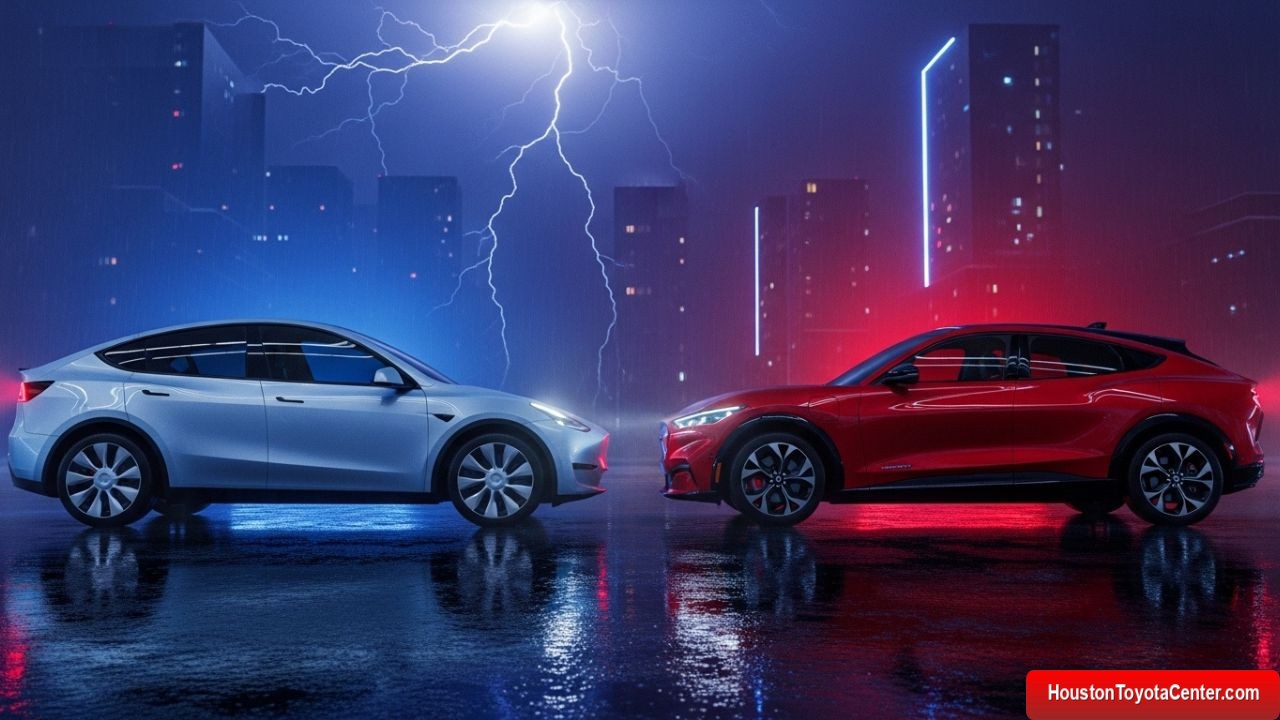
When it comes to electric SUVs, two names dominate the conversation — the Tesla Model Y and the Ford Mustang Mach-E. Both vehicles symbolize a shift in the automotive landscape, blending performance, technology, and sustainability in ways that appeal to both tech enthusiasts and everyday drivers. Yet, while they share similar goals, their approaches couldn’t be more different.
Tesla brings Silicon Valley innovation and a minimalist aesthetic, while Ford injects decades of muscle-car heritage and driving character into its electric SUV. This detailed comparison dives into every major aspect — performance, range, interior, design, technology, and overall value — to help you decide which one truly deserves your charge.
⚡ Powertrain and Performance
| Specification | Tesla Model Y Long Range | Ford Mustang Mach-E Premium (AWD) |
|---|---|---|
| Motor Setup | Dual Motor AWD | Dual Motor AWD |
| Horsepower | 384 hp (est.) | 346 hp |
| Torque | 376 lb-ft (est.) | 428 lb-ft |
| 0–60 mph | 4.8 seconds | 4.8 seconds |
| Top Speed | 135 mph | 124 mph |
Both SUVs deliver instant torque and exhilarating acceleration that makes traditional crossovers feel sluggish. The Model Y’s power delivery is razor-sharp, responding immediately to throttle input. The Mustang Mach-E, however, feels more muscular — its torque hits harder at lower speeds, giving it that classic Mustang punch.
Tesla still leads in straight-line performance, but Ford’s tuning makes the Mach-E feel sportier around corners. The Mach-E’s steering has more weight and feedback, and the suspension setup strikes a sweet balance between agility and comfort. Tesla’s setup leans toward efficiency, offering smooth and composed handling but less emotional engagement.
FREE: Quickly identify and understand problems with your vehicle 🚘
CLICK HEREIf your priority is raw speed, Tesla wins. But if you enjoy driving as an experience — the feel of the road and a responsive chassis — the Mach-E may surprise you.
🔋 Range and Charging
| Category | Tesla Model Y Long Range | Ford Mustang Mach-E Premium (Extended Range) |
|---|---|---|
| EPA Range | 330 miles | 310 miles |
| Battery Capacity | ~82 kWh | 91 kWh |
| 10–80% Fast-Charge Time | ~27 minutes (Supercharger V3) | ~45 minutes (DC Fast Charger) |
| Charging Network | Tesla Supercharger | BlueOval / Electrify America |
Tesla’s advantage remains its Supercharger network — a seamless ecosystem of reliable, high-speed chargers placed strategically across the country. Ford’s BlueOval network is growing rapidly and has recently gained access to Tesla’s Superchargers, which significantly narrows the gap.
In terms of range, the Model Y Long Range edges out the Mach-E, delivering about 20 more miles per charge. However, Ford’s battery management system is among the most refined in the industry, offering consistent real-world range that closely matches its EPA numbers — something Tesla has occasionally struggled with in varying climates.
If long-distance road trips and quick charging stops matter to you, Tesla remains the king. But Ford’s improving network access means the gap is shrinking fast.
🏎️ Driving Dynamics and Ride Comfort
Tesla’s approach to driving dynamics emphasizes efficiency and refinement, while the Mach-E delivers a more driver-focused experience.
The Model Y feels incredibly composed, with its low center of gravity and even power distribution between axles. It’s quiet, smooth, and ideal for daily commutes or long highway cruises. Yet, on rough roads, its firm suspension can feel a bit stiff — especially with larger wheels.
The Mustang Mach-E, in contrast, feels more alive. Its steering has genuine feedback, and the adaptive suspension (available on some trims) softens or tightens based on drive mode. Whether in Whisper, Engage, or Unbridled mode, the Mach-E manages to feel distinctively “Mustang” — muscular and spirited.
The result? The Model Y feels futuristic and calculated. The Mach-E feels like a real car you want to drive.
🖥️ Interior and Comfort
Tesla’s interior is famously minimalist — dominated by a single 15-inch touchscreen that controls almost everything. There are no traditional buttons or dials. The materials are eco-friendly but somewhat spartan, with synthetic leather and a flat dash.
The Ford Mustang Mach-E takes a different approach. It still feels modern, with a massive vertical 15.5-inch touchscreen running SYNC 4A, but it retains physical buttons for essentials like volume control and climate. The cabin has a warm, welcoming vibe, with textured surfaces, stitching, and more visual flair than Tesla’s cold simplicity.
Interior Highlights
| Feature | Tesla Model Y | Ford Mustang Mach-E |
|---|---|---|
| Main Display | 15” landscape touchscreen | 15.5” portrait touchscreen |
| Instrument Cluster | None (info on central screen) | 10.2” digital cluster |
| Materials | Vegan leather, minimalist | Softer-touch materials, accent stitching |
| Cabin Feel | Tech-oriented, futuristic | Sporty, premium, and familiar |
When it comes to comfort, both vehicles shine. The Model Y’s panoramic glass roof gives a spacious, open feel, while the Mach-E’s seats are more supportive for long drives. Tesla offers slightly more rear legroom and cargo space, thanks to its flat floor and efficient packaging.
Verdict: Tesla wins for futuristic simplicity, while Ford wins for tactile quality and driver comfort.
🧠 Technology and Infotainment
Tesla remains the benchmark for in-car technology. Its software is fast, visually clean, and updated over the air (OTA) regularly. The system can add new features, enhance range, and even introduce fun additions like games and light shows.
The Ford Mach-E’s SYNC 4A system is also capable of OTA updates and supports Apple CarPlay and Android Auto, something Tesla still refuses to include. Ford’s voice assistant is natural and responsive, while the interface is easier for new users to navigate.
| Tech Comparison | Tesla Model Y | Ford Mustang Mach-E |
|---|---|---|
| OTA Updates | Yes | Yes |
| CarPlay / Android Auto | No | Yes |
| Voice Assistant | Tesla Voice | Ford SYNC Voice |
| Driver Display | Central only | Dual-screen setup |
| Mobile App Integration | Tesla App (very advanced) | FordPass (feature-rich) |
Tesla’s app allows deep control — from climate preconditioning to Summon (autonomous parking). FordPass, while robust, doesn’t yet match Tesla’s ecosystem integration.
In short, Tesla’s software feels like an extension of your smartphone, while Ford’s feels like a more advanced version of traditional infotainment.
🚗 Design and Aesthetics
Design preference is subjective, but the differences here are striking.
The Tesla Model Y favors aerodynamic simplicity. Its smooth lines, frameless doors, and subtle curves prioritize function over form. Some call it sleek; others say it’s bland.
The Mustang Mach-E, however, embraces emotion. The sculpted hood, tri-bar taillights, and aggressive stance pay homage to its gasoline ancestor while staying distinctly futuristic. It turns heads, especially in bold colors like Rapid Red or Cyber Orange.
Design Verdict:
- Model Y — minimalist, aerodynamic, efficient.
- Mach-E — expressive, muscular, bold.
If you want to blend in, go Tesla. If you want to stand out, go Ford.
🧩 Practicality and Space
Tesla’s packaging efficiency shines again. The Model Y offers 68 cubic feet of cargo space (with rear seats folded) and an extra frunk (front trunk) for smaller items. The hatchback design makes loading easy, and rear passengers enjoy a panoramic roof and generous legroom.
The Mach-E is slightly smaller inside, offering 59.7 cubic feet of cargo space. It also includes a frunk, cleverly washable with a drain hole for wet gear — ideal for outdoor enthusiasts. The rear seats are comfortable but slightly more compact than Tesla’s.
Both are family-friendly, but Tesla’s layout maximizes utility, while Ford’s attention to detail gives it an edge in everyday convenience.
🧍 Safety and Driver Assistance
Both vehicles rank high in safety testing. The Tesla Model Y earned a 5-star NHTSA rating, thanks to its low center of gravity and strong structure. Ford’s Mach-E matches that rating and adds intuitive driver aids.
Tesla’s Autopilot is famous, offering lane-keeping, adaptive cruise, and semi-autonomous driving. The optional Full Self-Driving (FSD) promises more, though it remains controversial and in beta testing.
Ford’s BlueCruise system, on the other hand, allows true hands-free driving on over 130,000 miles of pre-mapped highways. It’s limited in scope but more consistent in performance.
| Feature | Tesla Model Y | Ford Mustang Mach-E |
|---|---|---|
| Adaptive Cruise | Yes | Yes |
| Lane-Centering | Yes | Yes |
| Hands-Free Highway Driving | No (hands-on required) | Yes (BlueCruise) |
| Collision Avoidance | Excellent | Excellent |
| Safety Rating | 5-Star NHTSA | 5-Star NHTSA |
Tesla’s cameras and neural network make it more futuristic, but Ford’s conservative approach feels more stable and predictable.
💰 Pricing and Value
| Trim | Tesla Model Y | Ford Mustang Mach-E |
|---|---|---|
| Base | $43,990 | $39,995 |
| Long Range / Premium | $48,990 | $46,995 |
| Performance / GT | $53,490 | $54,995 |
| Federal Tax Credit | Eligible (varies) | Eligible (varies) |
Tesla’s pricing fluctuates frequently, often due to real-time production costs and incentives. Ford’s pricing is more traditional, with fixed trims and packages.
Ford’s warranty also includes battery coverage for 8 years / 100,000 miles, matching Tesla’s. Maintenance costs are low for both, but Ford dealers still offer in-person support, whereas Tesla relies on remote diagnostics and mobile service.
🌱 Sustainability and Brand Philosophy
Tesla’s brand is built on innovation and disruption. Every Model Y is a statement of progress — a car that gets better over time through software. Its Gigafactories use renewable energy and recyclable materials wherever possible.
Ford, meanwhile, focuses on heritage meeting innovation. The Mach-E represents a bridge between the old and the new — a Mustang reborn for the electric age. It’s not about changing who Ford is, but evolving responsibly.
Both brands contribute to the EV revolution, but with different narratives.
- Tesla: “Technology leads change.”
- Ford: “Tradition can evolve.”
🧾 Ownership Experience
Tesla’s ecosystem is nearly seamless — from ordering online to receiving OTA updates, it’s all digital. However, that also means less human interaction when issues arise. Some owners report delays in service or inconsistent communication.
Ford’s dealer-based system ensures personal support, test drives, and faster problem resolution. The FordPass app and warranty services add reassurance for traditional buyers transitioning into the EV world.
Tesla wins on tech convenience. Ford wins on human touch.
🧩 Final Verdict: Tesla Model Y vs. Ford Mustang Mach-E
| Category | Winner |
|---|---|
| Performance | Tesla Model Y |
| Handling | Ford Mustang Mach-E |
| Range | Tesla Model Y |
| Charging Network | Tesla Model Y |
| Interior Design | Ford Mustang Mach-E |
| Technology | Tesla Model Y |
| Driver Assistance | Ford Mustang Mach-E |
| Value for Money | Ford Mustang Mach-E |
⚖️ Conclusion: Which One Should You Buy?
If you’re seeking the most advanced EV experience, the Tesla Model Y is unbeatable. Its software, range, and Supercharger access make it the gold standard for electric mobility. It’s a car that feels like the future — quiet, intelligent, and constantly evolving.
However, if you crave driving emotion and character, the Ford Mustang Mach-E offers something Tesla can’t replicate: soul. It’s not just efficient — it’s exciting. The Mach-E connects to the driver, offering warmth, personality, and a familiar touch in a world going digital.
In truth, neither car is a loser. The Tesla Model Y is the future, while the Ford Mustang Mach-E is the bridge that makes that future accessible — and fun.
So whether you prefer the surgical precision of Silicon Valley or the passionate roar of Detroit reinvented, both of these electric SUVs prove one thing:
The future of driving is electrifying — and it’s already here.
Leave a Reply