
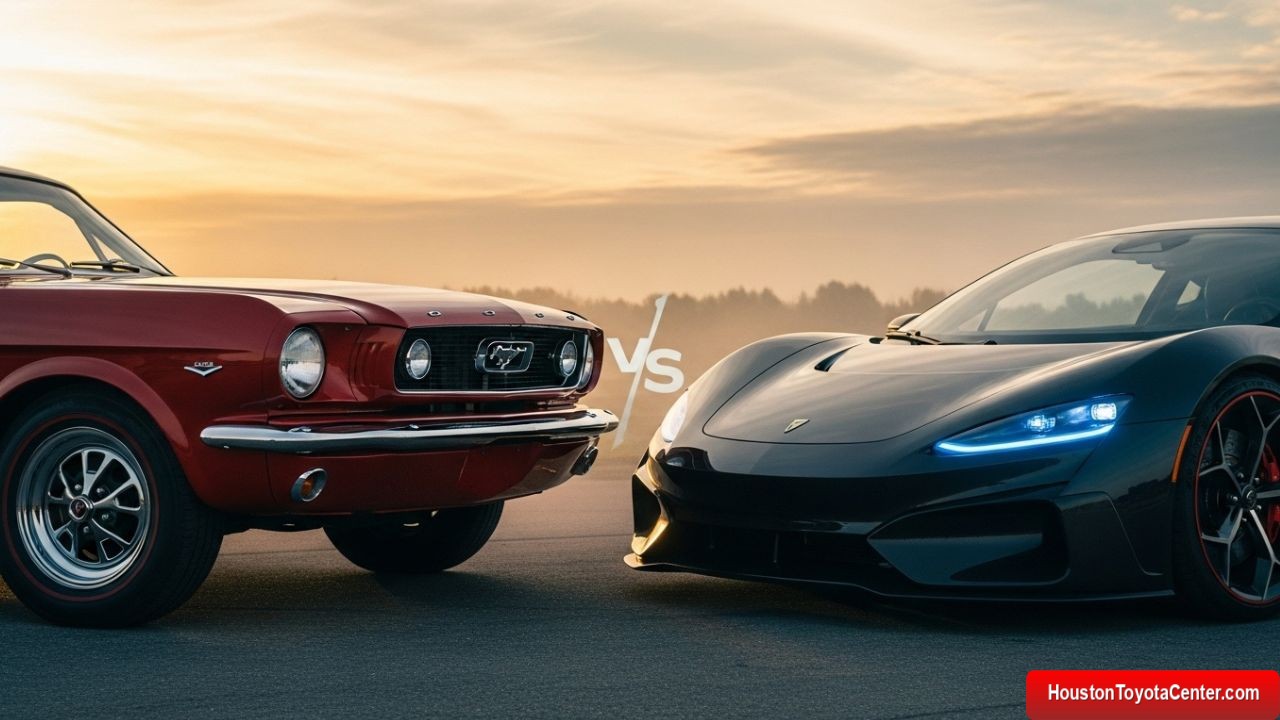
Few things ignite passion like the rumble of an engine and the gleam of polished chrome under the sun. Whether it’s the raw, mechanical beauty of a 1960s Mustang or the sleek, aerodynamic precision of a 2025 Porsche 911, cars have always been more than transportation—they’re a reflection of time, culture, and technology.
The debate between vintage and modern cars is as old as the vehicles themselves. Enthusiasts often find themselves split between nostalgia and innovation, between authenticity and advancement. What makes classic cars so enduringly captivating? And how do modern cars redefine the driving experience for a new generation?
Let’s take a deep drive into the aesthetics, performance, engineering, and emotion that separate—and connect—the two automotive worlds.
1. The Beauty of Design: When Art Meets Engineering
Classic cars are often described as rolling sculptures. Each curve, fin, and chrome accent was crafted by human hands and guided by artistic intuition rather than aerodynamic data.
FREE: Quickly identify and understand problems with your vehicle 🚘
CLICK HERETake, for instance, the 1957 Chevrolet Bel Air—with its sweeping lines and tailfins, it embodied post-war optimism. Or the Jaguar E-Type, once called “the most beautiful car ever made” by Enzo Ferrari himself.
Modern cars, by contrast, are designed by algorithms and wind tunnels. Efficiency is paramount. Sharp lines and sculpted aerodynamics are engineered for fuel economy and performance. A Tesla Model S or a Toyota Supra represents precision—a blend of design and data.
Key difference:
| Aspect | Vintage Cars | Modern Cars |
|---|---|---|
| Design process | Handmade artistry | Computer-aided design (CAD) |
| Shape influence | Aesthetic emotion | Aerodynamic optimization |
| Materials | Steel, chrome, wood | Carbon fiber, aluminum, composites |
| Design identity | Unique, handcrafted | Streamlined, futuristic |
Still, while modern cars boast perfection, imperfection is part of the charm of vintage ones. Every small quirk—uneven panel gap or carburetor cough—tells a story.
2. The Driving Experience: Feeling Every Vibration
Ask any classic car enthusiast what they love most, and the answer is usually the same: the connection. In a 1969 Camaro, you feel the vibration through the steering wheel. You smell the fuel. You shift gears with effort.
Modern cars, by comparison, often isolate the driver. With computer-assisted steering, traction control, and automatic transmissions, the driving experience has become smoother—but also more distant.
Yet, modern vehicles shine in responsiveness and safety. Electronic systems monitor everything in real time, making performance consistent and secure even for novice drivers.
| Experience Factor | Vintage Cars | Modern Cars |
|---|---|---|
| Steering | Manual, heavy feedback | Electronic, adaptive |
| Transmission | Manual (mostly) | Automatic, paddle-shift, or electric single-speed |
| Sound | Raw engine roar | Artificially tuned or silent (EVs) |
| Driver involvement | High | Moderate to low |
| Comfort | Minimal | Maximized |
The truth? Driving a classic car feels alive, unpredictable, and visceral. Modern cars, however, offer peace of mind and refinement—perfect for long trips or daily commutes.
3. Technology: From Carburetors to Code
When it comes to technology, modern cars dominate. They feature adaptive cruise control, AI-based navigation, lane assist, and self-driving capabilities. A 2025 Toyota Prius can literally drive itself in traffic while playing your favorite Spotify playlist.
In contrast, vintage cars are purely mechanical. Every part—the carburetor, distributor, spark plugs—operates visibly. This mechanical honesty appeals to enthusiasts who love to get their hands dirty under the hood.
| Feature | Vintage Cars | Modern Cars |
|---|---|---|
| Fuel system | Carburetor | Electronic fuel injection |
| Safety | Seatbelts (optional!) | Airbags, ABS, traction control |
| Infotainment | AM radio, cassette | Touchscreen, GPS, smartphone integration |
| Diagnostics | Manual inspection | Computer scanning |
| Automation | None | Semi or fully autonomous |
What vintage cars lack in digital sophistication, they make up for in mechanical transparency. There’s something deeply satisfying about knowing you can fix your car with a wrench rather than a software update.
4. Maintenance and Reliability: The Price of Passion
Owning a classic car isn’t just a hobby—it’s a commitment. Parts can be rare, maintenance can be tricky, and fuel efficiency is often dismal. But for many collectors, these challenges are part of the romance.
Vintage cars require constant attention. Regular oil changes, carburetor tuning, and brake adjustments are the norm. Modern vehicles, on the other hand, are practically maintenance-free by comparison—routine checks every few thousand miles and computer alerts for everything else.
| Category | Vintage Cars | Modern Cars |
|---|---|---|
| Reliability | Variable; depends on condition | High; factory-tested |
| Maintenance frequency | Frequent | Infrequent |
| Parts availability | Scarce or custom-made | Readily available |
| Mechanic expertise | Specialized, rare | Widespread, automated tools |
| Ownership cost | Can be high | Predictable |
For enthusiasts, though, the maintenance is part of the bond. Every time you restore a carburetor or polish chrome trim, you’re preserving history.
5. Emotion and Culture: The Soul of the Machine
Cars are emotional objects. They carry memories, freedom, and nostalgia. For many, vintage cars represent a golden age of design and simplicity, when people valued craftsmanship over convenience.
They evoke feelings of rebellion (think of James Dean’s Porsche 550 Spyder) or sophistication (a Rolls-Royce Silver Cloud gliding through London). They remind us of road trips with family, drive-in theaters, or the smell of gasoline on summer nights.
Modern cars, by contrast, embody ambition and innovation. They represent our progress toward sustainability and technology. Electric vehicles like the Tesla Model 3 or the Toyota bZ4X symbolize a future where performance and responsibility coexist.
In short:
- Classic cars speak to the heart.
- Modern cars speak to the mind.
6. Sustainability: A New Kind of Responsibility
The automotive world has changed. With climate concerns at the forefront, sustainability is no longer optional.
Classic cars, while beautiful, are not eco-friendly. They lack catalytic converters, burn more fuel, and emit more CO₂. However, enthusiasts are finding creative ways to adapt—such as electric conversions of vintage models. A restored 1965 Mustang with an electric motor combines nostalgia with eco-consciousness.
Modern cars, on the other hand, lead the charge with hybrid and electric technologies. Toyota, Tesla, and Ford are redefining what performance means without sacrificing the planet.
| Sustainability Aspect | Vintage Cars | Modern Cars |
|---|---|---|
| Fuel type | Gasoline | Hybrid, electric, hydrogen |
| Emissions | High | Low or zero |
| Recyclability | Moderate | High (eco materials) |
| Longevity | Long, if maintained | Long, with lower environmental impact |
It’s not about competition—it’s about coexistence. Classic cars remind us where we came from, while modern cars show us where we’re going.
7. Value and Investment: The Rise of the Classic Market
One surprising fact: while modern cars depreciate the moment you drive them off the lot, many classic cars appreciate in value over time.
A 1970 Dodge Charger that sold for $3,000 decades ago might fetch over $150,000 today. Collectors view these vehicles as not only art pieces but financial assets.
| Type | Value Trend | Reason |
|---|---|---|
| Vintage cars | Increasing (rarity and nostalgia) | Collectibility, cultural value |
| Modern cars | Depreciating | Rapid tech obsolescence |
But beware: not all classics are gold mines. Maintenance costs can outweigh profit, and authenticity matters—cars with original parts or rare trims often skyrocket in price.
8. The Modern Revival: Neo-Retro Cars
Interestingly, modern manufacturers are reviving the past. Models like the Ford Bronco, Chevrolet Camaro, and Toyota Supra blend classic silhouettes with modern performance.
This neo-retro movement appeals to both generations—those nostalgic for the old, and those fascinated by the new.
For example:
- The Mini Cooper retains its quirky charm but adds turbocharged engines and infotainment systems.
- The Fiat 500 mirrors its vintage predecessor but offers electric versions.
- The Toyota Supra GR fuses 1990s spirit with BMW engineering.
It’s proof that design nostalgia never dies—it just evolves.
9. The Future of Car Enthusiasm
As cars become increasingly digital and autonomous, a new question emerges: will future generations still care about driving?
For vintage lovers, the answer is yes. There’s an unspoken joy in restoring something mechanical, hearing it roar back to life, and knowing every click and bolt. For others, the excitement of software updates, self-parking systems, and AI co-pilots defines the new frontier.
What unites both camps is passion. Whether through petrol or electricity, car culture thrives because it’s about emotion, identity, and movement.
10. Conclusion: Two Eras, One Passion
Vintage cars remind us of where we came from—a time when driving was an experience, not a function. Modern cars show us where we’re going—a future of safety, innovation, and sustainability.
There’s no true winner in the debate. Each era has its own soul:
- Vintage cars are poetry written in steel.
- Modern cars are symphonies of technology.
And in the end, both celebrate the same dream: freedom on four wheels.
Leave a Reply