
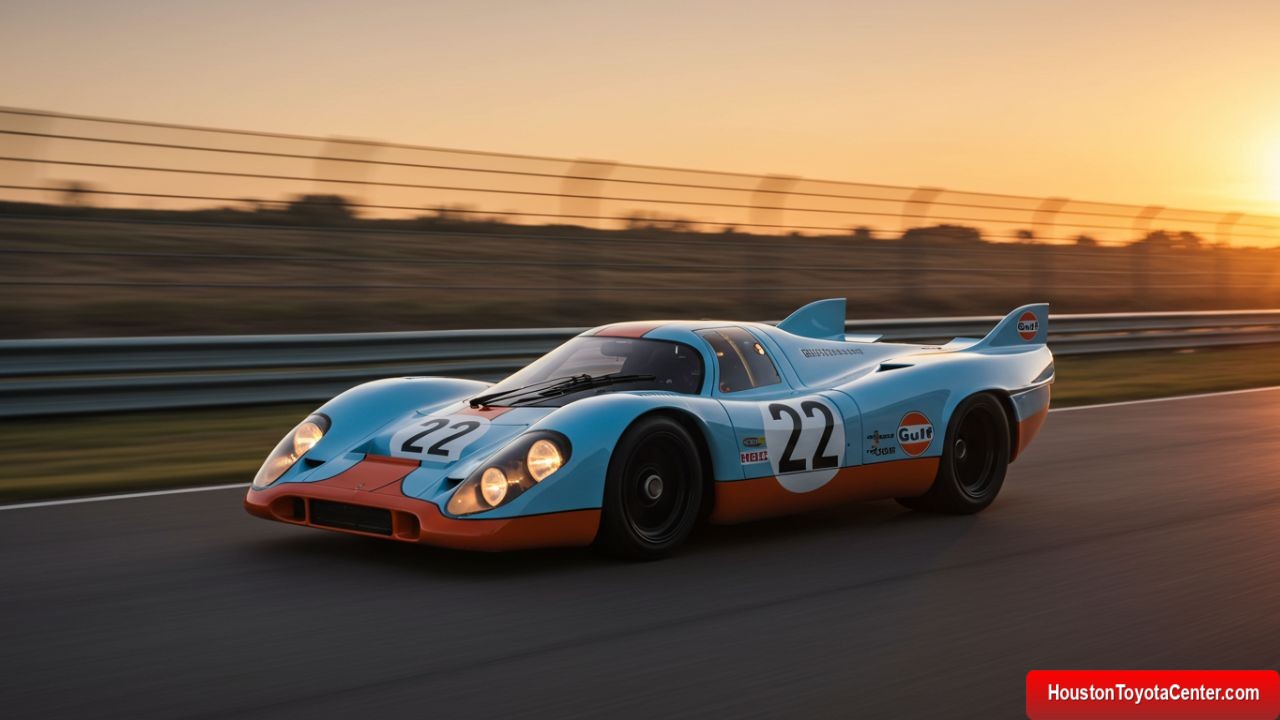
In an age where modern supercars are engineered with cutting-edge technology, state-of-the-art materials, and advanced aerodynamics, it seems almost impossible to imagine that a car built over 50 years ago could outperform them in raw speed and acceleration. Yet, there exists a legendary machine from the past that defies all expectations — a car so ahead of its time that even today’s most sophisticated supercars struggle to keep up.
This is not just a story about nostalgia or vintage charm. It’s about pure performance, innovative engineering, and a level of craftsmanship that created a masterpiece capable of outpacing even the most advanced vehicles of the 21st century. In this article, we’ll explore why this 50-year-old car is still faster than modern supercars, delving into its design, engineering, and the factors that contribute to its unmatched performance.
🏎️ The Car That Defies Time
The car in question is the Porsche 917, built in 1969 and refined over the following years to become one of the most dominant racing machines ever created. It wasn’t just fast for its time — it was revolutionary. The Porsche 917 shattered records and became a legend in motorsport history, securing its place as one of the most formidable cars ever built.
Key Specs of the Porsche 917 (1970 Version):
| Specification | Value |
|---|---|
| Engine | 4.5-liter Flat-12 |
| Power Output | 580 hp at 8,300 rpm |
| Weight | 800 kg (1,764 lbs) |
| Top Speed | Over 240 mph (386 km/h) |
| 0-60 mph | 2.3 seconds |
| Transmission | 5-speed manual |
To put this into perspective, the Bugatti Chiron, one of the fastest modern hypercars, takes 2.4 seconds to reach 60 mph — slightly slower than the Porsche 917, which was built over five decades ago!
FREE: Quickly identify and understand problems with your vehicle 🚘
CLICK HERE🛠️ Engineering Masterpiece
The Porsche 917 wasn’t just fast because of its powerful engine; it was an engineering marvel that combined lightweight construction, innovative aerodynamics, and precise weight distribution.
1. Lightweight Chassis and Body
The 917 was built using a lightweight aluminum spaceframe, which reduced its overall weight to just 800 kg — lighter than many modern hatchbacks! This gave it an extraordinary power-to-weight ratio, making it easier to accelerate and maintain high speeds.
2. Advanced Aerodynamics
Aerodynamics played a crucial role in the Porsche 917’s dominance. Porsche engineers spent countless hours in wind tunnels refining the car’s body to minimize drag and maximize downforce.
- Early versions of the 917 experienced instability at high speeds due to lift at the rear.
- Engineers introduced a “long-tail” (917 LH) version and a more balanced “short-tail” (917 K) model, which improved handling and stability at extreme speeds.
3. Powerful Flat-12 Engine
The heart of the 917 was its monstrous 4.5-liter Flat-12 engine, which was later upgraded to a 5.0-liter version in some racing variants.
- The engine was air-cooled and featured dual overhead camshafts (DOHC), a revolutionary setup at the time.
- The use of Bosch mechanical fuel injection allowed precise fuel delivery, enhancing both power output and throttle response.
4. Innovative Materials
The Porsche 917 utilized lightweight materials like magnesium and titanium to keep the weight down without sacrificing strength.
- The wheels were made of magnesium alloy, reducing unsprung weight.
- The frame was hand-welded from aluminum tubing, contributing to its incredible stiffness and lightness.
🏁 How It Compares to Modern Supercars
So, how does a 50-year-old car manage to outperform modern supercars packed with cutting-edge technology?
1. Weight vs. Power Ratio
One of the key advantages of the Porsche 917 is its exceptionally low weight. Modern supercars are often burdened by complex electronic systems, heavy batteries (in hybrid models), and larger engines.
- The Porsche 917 had a power-to-weight ratio of 725 hp/ton — significantly higher than most modern supercars.
- For comparison, the Bugatti Chiron has a power-to-weight ratio of 625 hp/ton despite producing nearly 1,500 hp.
2. Simplicity and Mechanical Purity
Modern supercars are highly dependent on electronic aids like traction control, launch control, and active suspension. While these systems enhance drivability, they also add weight and complexity.
- The Porsche 917 relied purely on mechanical grip and driver skill.
- Without electronic interference, the driver had a direct connection to the car’s performance.
3. Aerodynamics
While modern cars benefit from computational fluid dynamics (CFD) and active aerodynamics, the 917’s fixed aerodynamic design was so well-executed that it provided exceptional downforce without adding drag.
- The long-tail version (917 LH) had a drag coefficient of just 0.29 — better than many modern supercars.
4. Tire Technology
Modern supercars have the advantage of modern tire compounds and wider contact patches, but the 917’s lightweight chassis and low center of gravity allowed it to generate exceptional grip even with narrower tires.
🏆 Why the Porsche 917 Is Still a Benchmark
The Porsche 917 didn’t just win races — it dominated them.
- It won the 24 Hours of Le Mans in 1970 and 1971, setting speed and endurance records that remained unbroken for years.
- In 1971, a Porsche 917 set the fastest lap ever recorded at Le Mans, averaging 150 mph (241 km/h) over the 8.5-mile course.
Notable Achievements:
| Year | Event | Result |
|---|---|---|
| 1970 | 24 Hours of Le Mans | 1st Place |
| 1971 | 24 Hours of Le Mans | 1st Place |
| 1971 | Nürburgring 1000 km | 1st Place |
| 1971 | Spa 1000 km | 1st Place |
🚀 Legacy and Influence on Modern Supercars
The Porsche 917 set the template for modern supercars in several ways:
✅ Lightweight materials and construction techniques
✅ Aerodynamic efficiency
✅ Powerful, naturally aspirated engines
✅ Focus on driver connection and mechanical purity
Modern cars like the Porsche 911 GT2 RS, Ferrari LaFerrari, and McLaren P1 owe much of their design philosophy to lessons learned from the 917.
🎯 Why It Still Matters Today
Despite the technological advancements of modern supercars, the Porsche 917 remains a benchmark of pure performance. Its lightweight construction, raw power, and aerodynamic efficiency are testaments to the brilliance of 1970s engineering.
If you ever get the chance to see (or hear) a Porsche 917 in action, you’ll understand why it’s more than just a fast car — it’s a piece of automotive history that refuses to be outdone, even by the best that modern technology has to offer.
🏁 Conclusion
The Porsche 917 isn’t just faster than modern supercars — it’s proof that exceptional engineering and design can transcend time. In an era where speed is often defined by technology and software, the 917 stands as a reminder that raw mechanical power, lightweight construction, and clever aerodynamics are the true keys to speed.
Even after 50 years, the Porsche 917 remains one of the fastest and most impressive machines ever created — a timeless icon that modern supercars are still trying to catch up to.
🔥 Fast cars come and go, but legends like the Porsche 917 are eternal.
Leave a Reply